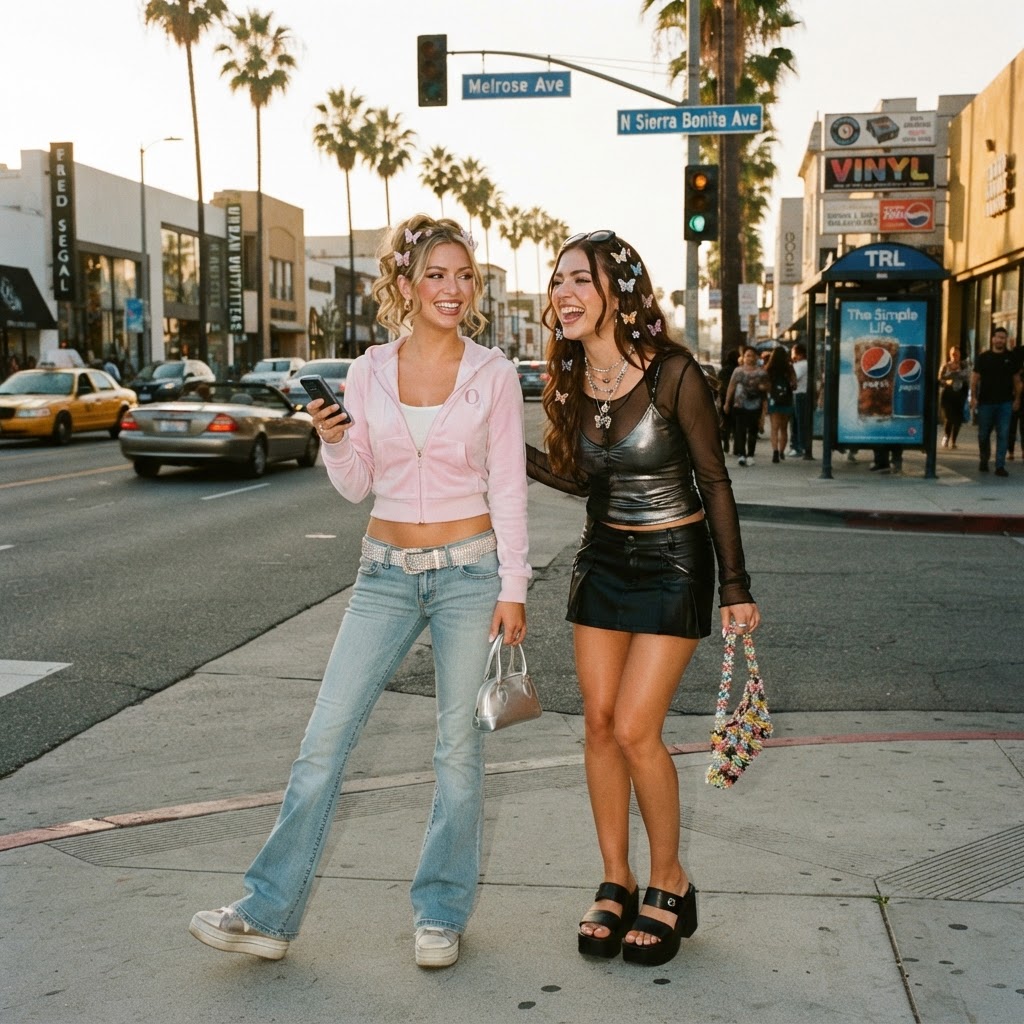
Y2K Fashion Is Back: Why the Late '90s and Early 2000s Are Having Their Biggest Moment Yet
Low-rise jeans, butterfly clips, and bedazzled everything — Y2K fashion has officially left the archives and taken over your feed. But this revival is more than just nostalgia; it's a full-blown cultural reckoning with an era that was bolder, shinier, and more unapologetic than we ever gave it credit for. Here's why Y2K is trending again, and how to wear it right.
The Return of the Future That Never Was
At the turn of the millennium, the world was gripped by two competing anxieties: the fear that computers would crash civilization at midnight, and the giddy hope that the future was finally, officially here. Fashion absorbed both of those feelings with remarkable enthusiasm. Y2K fashion — broadly defined as the aesthetic spanning the late 1990s through the early 2000s, roughly 1997 to 2004 — was futuristic and playful, maximalist and sometimes gloriously absurd. Metallic fabrics caught the light like disco balls. Platform sneakers added inches of optimism. Velour tracksuits whispered luxury in pastel tones.
For a long stretch, most of this was quietly packed away, filed under "what were we thinking?" But somewhere around 2020, a generation of young shoppers began pulling these pieces back out — and they haven't stopped since.
Why Y2K? Why Now?
Fashion history tends to run on a roughly 20-year nostalgia cycle. The decade that felt embarrassing in real time becomes irresistible once enough distance accumulates. We saw it with '70s revival in the '90s, with '80s power dressing making a triumphant return in the 2000s, and with '90s minimalism flooding runways throughout the 2010s. By that logic, the Y2K moment was always coming — but several forces have turbocharged its arrival.
First, there's TikTok and the visual economy of Gen Z. Short-form video rewards bold, immediately recognizable aesthetics. Y2K delivers exactly that: a look is identifiable in a single frame. A Von Dutch trucker hat, a pair of ultra-low-rise flares, a rhinestone-encrusted phone case — each item is a visual shorthand for an entire cultural attitude. Gen Z, raised on algorithmic content, has proven exceptionally skilled at mining the recent past for potent imagery.
Second, there's the sustainability conversation. As more consumers become conscious of fast fashion's environmental toll, vintage and secondhand shopping have gained enormous appeal. Y2K pieces are old enough to feel authentically vintage but recent enough that they're still widely available in secondhand markets — which makes them a sweet spot for eco-minded shoppers who also want something with real visual punch.
Third — and perhaps most interestingly — there's a certain emotional reclamation happening. Many of the people now celebrating Y2K fashion were children or teenagers during that era. They remember being told that low-rise jeans were unflattering, that trucker hats were tacky, that Juicy Couture tracksuits were the province of reality TV excess. Wearing these pieces now, with intention and self-possession, is a way of saying: we get to decide what's beautiful.
The Key Pieces Defining the Y2K Revival
Not everything from the early aughts has made the comeback cut, but several signature pieces are absolutely dominating vintage markets right now.
Low-Rise Denim remains the most debated item in the revival, but it's undeniably central to the Y2K silhouette. Whether in dark wash bootcut or bleached flare, authentic vintage low-rise jeans from brands like Miss Sixty, Frankie B., and early True Religion carry a weight of authenticity that modern reproductions simply can't replicate.
Velour and Terry Cloth Tracksuits — particularly in the pastel and deep jewel tones popularized by Juicy Couture — have become trophy pieces in vintage collections. Original early-2000s sets in good condition are increasingly hard to find and increasingly valuable.
Mesh and Sheer Layering was everywhere in this era, from mesh tops worn over sports bras to sheer blouses with contrast camisoles beneath. This layered, skin-teasing approach to dressing feels remarkably current in an era when "quiet luxury" and "loud maximalism" are competing for the same closet space.
Mini Skirts and Micro Minis, particularly in plaid, pleather, or denim, defined the early 2000s party look. Paired with knee-high boots or chunky mules, they read as effortlessly cool rather than costume-y when styled with a modern eye.
Logomania and Branding was perhaps never more overt than in this period. Fendi baguettes, Louis Vuitton monogram, Coach signature canvas — the visible logo was not a vulgarity but a statement of arrival. Authentic Y2K-era logo pieces have become serious collectibles.
Butterfly Clips, Bandanas, and Hair Scarves round out the accessories picture. The beauty of Y2K accessories is that they're often affordable entry points into the aesthetic — a small investment that signals big commitment to the look.
How the Runways Validated the Streets
The Y2K revival didn't emerge from high fashion — it bubbled up from thrift stores, vintage markets, and social media. But the runways have since caught up and amplified the moment considerably. Miu Miu sent low-rise micro-minis down the runway and created one of the defining fashion conversations of recent years. Blumarine leaned into rhinestone embellishment and cutout silhouettes straight from the early aughts playbook. Diesel repositioned itself as a prestige brand by leaning into its own Y2K heritage.
When high fashion validates a street trend, two things happen: the aesthetic gains legitimacy with consumers who look to the runway for cues, and authentic vintage pieces from that era spike in value. We've watched this play out in real time with Y2K. The window to acquire genuine pieces at accessible prices is narrowing.
Styling Y2K Vintage for a Modern Wardrobe
The key to wearing Y2K vintage without looking like you raided a time capsule is intentional contrast. Pair an era-authentic bandeau top with wide-leg tailored trousers rather than the matching low-rise jeans — it grounds the vintage piece in a contemporary silhouette. Let a velour hoodie serve as the focal point of an otherwise neutral, minimalist outfit. Use Y2K accessories — a beaded bag, a logo belt, platform sandals — to add a pop of era-specific personality to something otherwise simple.
The goal is conversation, not costume. When a vintage piece is chosen with care and worn with confidence, it tells a story. It carries the actual weight of the moment it was made in — the optimism, the excess, the pop-cultural electricity of that specific turn-of-the-millennium energy. No reproduction can manufacture that.
Why Authentic Vintage Always Wins
The contemporary fashion market has responded to the Y2K revival predictably: fast fashion brands have flooded shelves with Y2K-inspired pieces at low price points. And while imitation is flattery, there's a profound difference between a genuine early-2000s Miss Sixty flare and a 2024 fast-fashion approximation. The original carries real history — it was made in the era, worn in the era, survived the intervening decades. It has texture, character, and provenance that simply cannot be manufactured on demand.
There's also the sustainability argument, which circles back to why so many Y2K enthusiasts are shopping vintage in the first place. Buying authentic secondhand clothing is a direct rejection of the cycle of overproduction that fast fashion depends on. The piece already exists. Choosing it over something new made in its image is a genuinely meaningful choice.
Conclusion: Find Your Y2K Moment at Ensemble
The Y2K revival is not a passing trend — it's a full cultural rehabilitation of an era that deserves to be understood on its own terms: bold, boundary-pushing, and utterly committed to making an impression. Whether you're building a serious vintage collection or simply looking for one statement piece that captures the spirit of the early aughts, authentic Y2K clothing offers some of the most exciting shopping available in the vintage market right now.
At Ensemble, our marketplace is home to carefully authenticated pieces spanning the 1920s through the 2010s — including a growing selection of genuine Y2K-era clothing and accessories from sellers who know their decades. Browse our Y2K collection to find the real thing: the actual fabrics, the actual cuts, the actual spirit of a moment that the world is finally ready to fully appreciate. The future was then. And it looks better than ever.