Vintage, Antique, or Retro? The Ultimate Guide to Fashion Terminology
If you've ever described a 1970s floral blouse as 'retro' only to be gently corrected by a seasoned thrifter, you're not alone. The words vintage, antique, and retro get tossed around interchangeably in fashion circles — but they actually mean very different things. Understanding the distinction will sharpen your eye, elevate your shopping game, and deepen your appreciation for the clothes that history left behind.
Why the Labels Matter
Walking into a vintage market or browsing an online fashion marketplace can feel like stepping into a different language. Tags read vintage, retro, antique, period piece, deadstock — and the prices shift dramatically depending on which word is used. These aren't just marketing buzzwords. Each term carries a specific meaning rooted in age, origin, and intent, and knowing the difference can mean the gap between a savvy purchase and an expensive mistake.
Whether you're a seasoned collector or just beginning to explore pre-owned fashion, this guide will break down each category clearly so you can shop with confidence.
What Does "Vintage" Actually Mean?
Vintage fashion refers to clothing and accessories that are at least 20 years old but no more than 100 years old. In 2025, that means anything produced between roughly 1925 and 2005 can technically qualify as vintage — though the term is most commonly applied to pieces from the 1920s through the early 2000s.
The word vintage itself is borrowed from the wine world, where it describes a wine from a specific and notable year of harvest. Applied to fashion, it carries a similar connotation: not just old, but representative of its era. A genuine vintage piece doesn't just date from a certain decade — it authentically reflects the silhouettes, fabrics, construction techniques, and cultural attitudes of that time.
This is where quality becomes crucial. True vintage garments were often made with superior craftsmanship compared to today's fast fashion. A 1960s wool coat, for example, may feature hand-stitched lining, sturdy horn buttons, and a structured cut that modern manufacturing rarely replicates. These qualities are part of what makes vintage fashion so desirable.
Common vintage eras and their signatures:
- 1920s–1930s: Art Deco beading, bias-cut silhouettes, silk charmeuse
- 1940s–1950s: Nipped waists, full skirts, utilitarian wartime fabrics
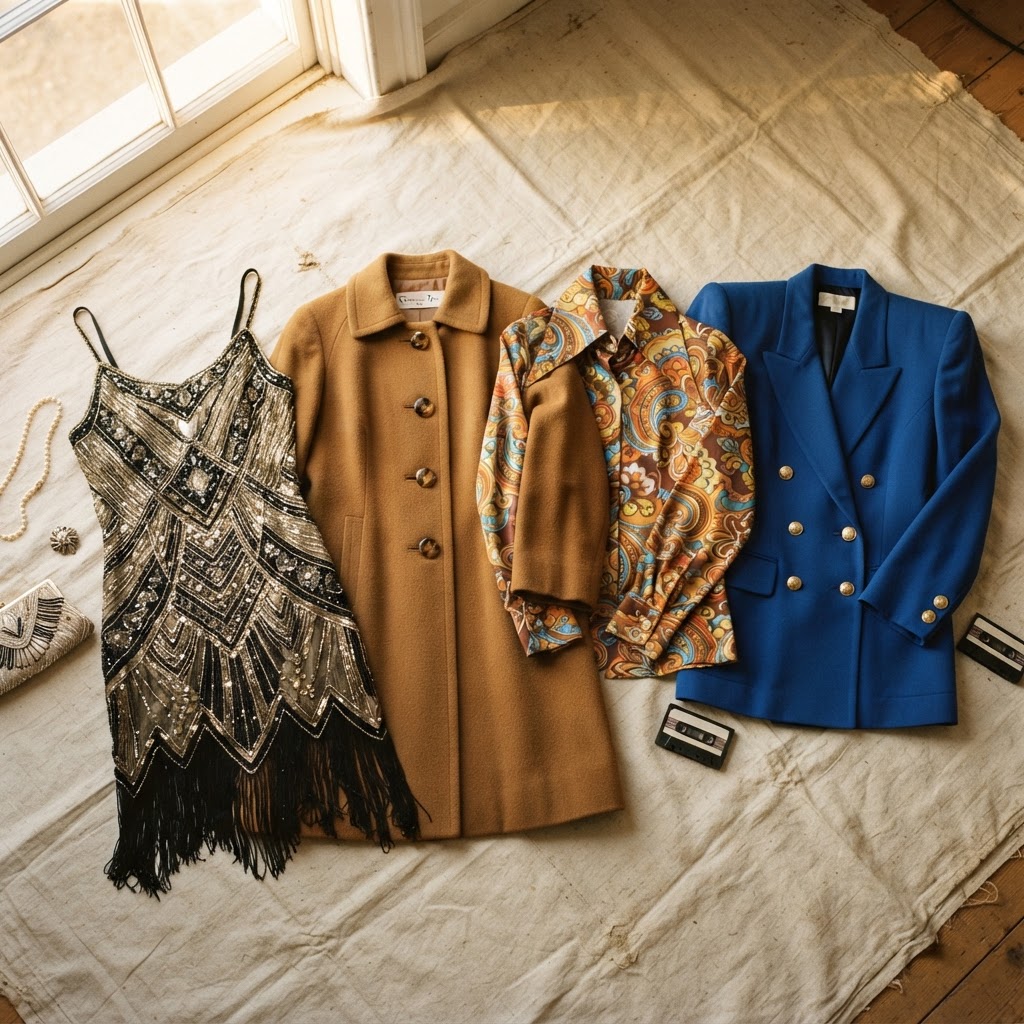
- 1960s–1970s: Mod geometry, psychedelic prints, wide lapels and flares
- 1980s–1990s: Power shoulders, neon palettes, grunge and minimalism
- Early 2000s: Low-rise denim, logomania, Y2K futurism
What Makes Something "Antique"?
Antique fashion takes things a step further back in time. Generally accepted by collectors, dealers, and even customs agencies worldwide, the threshold for an antique is 100 years or older. In 2025, that means clothing and accessories made before 1925 fall into this category.
Antique garments are rare and historically significant. Think Edwardian lace blouses, Victorian mourning dresses, Belle Époque corsets, or early 20th-century beaded evening wear. These pieces are as much artifacts as they are clothing — handled with the care of museum objects and priced accordingly.
Because antique garments are so fragile and irreplaceable, they are rarely worn in everyday contexts. Collectors acquire them for display, archival preservation, or costume research. Fabric degradation, faded dyes, and structural fragility are common concerns. Even proper storage requires acid-free tissue paper and climate-controlled environments.
If you encounter a piece described as antique at a fashion marketplace, expect rigorous documentation of its provenance and condition. Authentication matters enormously at this level, and reputable sellers will provide detailed historical context.
So What Is "Retro" Fashion?
Here's where the confusion most often arises. Retro fashion is not defined by the age of the garment — it's defined by intentional stylistic imitation. A brand-new dress designed to evoke the 1950s silhouette with a full skirt and structured bodice is retro. A reproduction of a 1970s paisley shirt printed and sewn last year is retro.
The word itself comes from the Latin retro, meaning "backward" or "in past times," and that's exactly the spirit: retro fashion looks back rather than being from the past. It is contemporary in manufacture but nostalgic in aesthetic.
Retro clothing is widely available on the high street and through independent designers who specialize in era-inspired looks. Brands like Stop Stitch, Collectif, and Hell Bunny have built entire businesses around retro aesthetics. These pieces are accessible, often machine-washable, and sized to modern body standards — making them a practical entry point for people who love the look of a certain era but want the convenience of new clothing.
The key distinction: Retro is inspired by the past. Vintage is the past.
Deadstock and Reproduction: Two Bonus Terms
While we're clarifying terminology, two more labels deserve attention.
Deadstock refers to old, unused inventory — clothing that was manufactured in a past era but never sold or worn. Deadstock items are technically vintage by age but are often in pristine, unworn condition because they sat in a warehouse or stockroom for decades. Finding deadstock is considered a major score among collectors because you get period-authentic construction with near-new condition.
Reproduction clothing is similar to retro in that it's newly made, but reproductions are specifically designed to be accurate historical replicas rather than loosely inspired interpretations. A reproduction 1940s utility blouse might use period-correct patterns, buttons, and stitching techniques, whereas a retro blouse from the same era would simply borrow the silhouette and adapt everything else to modern standards.
Why This Matters When You're Shopping
Understanding these distinctions protects you as a buyer. A seller labeling a newly made dress as "vintage" is either mistaken or misleading. Conversely, dismissing a genuinely rare 1930s beaded gown as "just retro" would be a significant oversight.
Here are a few practical tips for identifying authentic vintage pieces:
- Check the label. Union labels, care instruction formats, and brand typography all changed across decades. A garment claiming to be from the 1950s with a care label listing washing machine instructions is suspicious — standardized care labels weren't required in the US until 1971.
- Examine the construction. Hand-finishing, natural fibers, metal zippers (rather than nylon or plastic), and flat-felled seams are hallmarks of older garments.
- Look at the hardware. Buttons, zippers, hooks, and snaps evolved over time. Vintage zipper brands like Talon and Conmar can help date a piece precisely.
- Know the silhouettes. Fashion silhouettes shifted dramatically decade by decade. Familiarizing yourself with period-specific shapes makes it much easier to spot anachronisms.
- Ask questions. Reputable sellers will always be able to tell you more about a piece's provenance and dating methodology.
The Cultural Value of Getting It Right
Beyond the practical, there's a deeper reason to care about these distinctions. Fashion is material culture — it tells us who people were, what they valued, how they moved through the world. A 1940s women's suit speaks to wartime resourcefulness and the slow expansion of women into the professional workforce. A 1980s power blazer narrates an entire feminist movement through shoulder pads.
When we casually conflate retro with vintage or use antique loosely, we risk flattening these stories. Precision in language is a form of respect for the people who wore these clothes first.
Discover Authentic Pieces at Ensemble
At Ensemble, we believe that every garment has a story worth telling — and worth wearing. Our curated marketplace features authenticated clothing and accessories spanning the 1920s through the 2010s, each piece verified for era-authenticity and described with the transparency you deserve. Whether you're hunting for a genuine 1960s mod mini dress, a deadstock 1980s bomber jacket, or a delicate pre-war silk blouse, Ensemble is your destination for fashion history you can actually wear.
Now that you know the difference between vintage, antique, and retro — you're ready to shop like an expert. Browse our collections today and find the era that speaks to you.