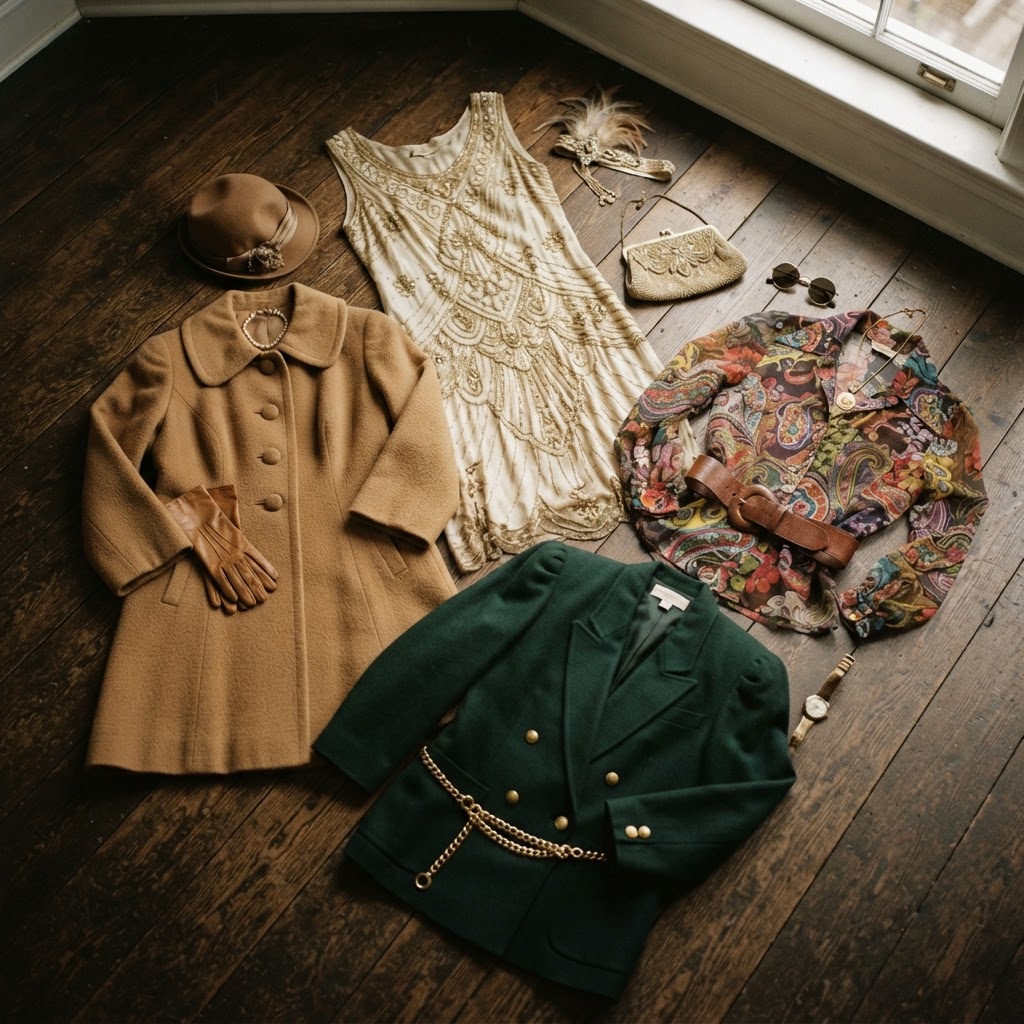
Vintage, Antique, or Retro? The Ultimate Guide to Fashion Terminology
If you've ever scrolled through a secondhand marketplace and wondered whether that '70s wrap dress is truly 'vintage' or just 'retro,' you're not alone. The world of pre-loved fashion has its own language, and knowing the difference can save you money, sharpen your eye, and make you a far more confident shopper. Let's break it all down.
Why the Labels Matter
When you're hunting for that perfect piece of pre-loved clothing, the words used to describe it aren't just marketing fluff — they carry real meaning. Vintage, antique, and retro are three of the most commonly used (and most commonly confused) terms in the fashion resale world. Using them correctly helps you communicate with sellers, understand pricing, and set accurate expectations about what you're actually buying. Whether you're a seasoned collector or a curious first-timer, this guide will give you the vocabulary you need to shop with confidence.
What Does "Vintage" Actually Mean?
The term vintage is the most widely used — and widely misused — label in secondhand fashion. In the strictest sense, a garment is considered vintage if it is at least 20 years old and is representative of the era in which it was made. So as of today, anything produced in the early 2000s or earlier can technically qualify.
But age alone isn't enough. A true vintage piece should reflect the aesthetic, construction techniques, and cultural moment of its time. A plain white T-shirt from 2001 is old, but it's not vintage in any meaningful sense. A beaded shift dress from the same year that captures early-aughts minimalism? That's a different story.
Vintage fashion spans a remarkably wide range of decades — from the structured elegance of 1940s tailoring to the bold color-blocking of 1980s power suits. Each era has its own hallmarks:
- 1920s–1930s: Art Deco beading, bias-cut silhouettes, silk charmeuse
- 1940s–1950s: Nipped waists, full skirts, utilitarian wartime cuts
- 1960s–1970s: Mod geometrics, flared denim, psychedelic prints
- 1980s–1990s: Oversized blazers, acid wash, minimalist slip dresses
When a marketplace like Ensemble lists a piece as vintage, it means the item has been authenticated as a genuine product of its era — not a modern reproduction.
What Makes Something "Antique"?
In the fashion world, antique clothing refers to garments that are at least 100 years old. This threshold is borrowed from the broader antiques trade, where the century mark separates true antiques from more recent collectibles.
Antique clothing is extraordinarily rare and requires careful handling. We're talking about Edwardian lace blouses, Victorian mourning gowns, 1920s flapper dresses, and early Art Nouveau textiles. These pieces are less likely to be worn regularly and more likely to be treated as wearable art or collectibles.
Because antique garments predate synthetic fibers, they are typically made from natural materials like cotton, wool, silk, and linen. The construction is often entirely hand-sewn or features early machine stitching that looks nothing like modern manufacturing. When you handle an antique garment, you're holding a piece of history — which is precisely why condition, storage, and provenance matter so much at this level of the market.
At Ensemble, our antique offerings — primarily pieces from the 1920s — are carefully curated and described with detailed condition notes. Shopping antique isn't just a fashion choice; it's a form of preservation.
So What Is "Retro" Fashion?
Here's where things get interesting — and where the most confusion tends to arise. Retro fashion does not refer to the age of the garment at all. Instead, retro describes new or newer clothing that is deliberately designed to evoke a past era.
Think of a brand-new dress made today that mimics the silhouette of the 1950s, or a freshly manufactured tracksuit styled after 1980s athletic wear. These items are retro in aesthetic, but they are not vintage — they were made recently and simply take inspiration from the past.
The word retro comes from the Latin retro, meaning "backward" or "behind," and that's exactly the spirit: looking backward for style inspiration while producing something new. Retro pieces can be fantastic wardrobe additions, but it's important to understand that you're buying a contemporary interpretation, not an authentic artifact.
Key differences to remember:
- Vintage = genuinely old, from the era it represents
- Antique = genuinely old, 100+ years
- Retro = new, but styled to look old
How to Tell the Difference When Shopping
Knowing the definitions is one thing — being able to spot them in the wild is another. Here are some practical tips for distinguishing authentic vintage and antique pieces from retro reproductions.
Check the Label
Clothing labels are one of the most reliable dating tools available. Union labels, care instruction formats, and country of origin text all changed significantly across decades. For example, U.S. law didn't require fiber content on labels until 1960, and "Made in China" labels didn't become common until the late 1970s and 1980s. A garment claiming to be from the 1950s with a fiber content label is almost certainly a later reproduction.
Examine the Construction
Authentic vintage and antique garments often show hand-finishing, metal zippers (plastic zippers weren't widespread until the 1960s), and seam techniques that differ from modern mass production. Look on the inside of the garment — the quality and method of construction tells a story.
Feel the Fabric
Older textiles have a distinct weight, drape, and hand-feel that modern reproductions often struggle to replicate. Pre-1950s fabrics are almost always natural fibers. Synthetic blends became dominant in the late 1960s and 1970s, so a fabric composition can help narrow down a date range significantly.
Look at the Silhouette and Hardware
Every decade had its signature shape. If you know your fashion history, you can often date a piece within a five- to ten-year window just by its cut. Buttons, snaps, and hardware also evolved over time — early plastic buttons look and feel different from modern ones, and certain decorative styles are strongly tied to specific eras.
Does It Matter Which Term You Use?
Absolutely — especially when money is involved. Antique garments command the highest prices due to their rarity and age. Vintage pricing varies widely depending on the decade, condition, designer, and desirability. Retro pieces, being newly made, are typically priced like contemporary clothing.
Mislabeling is unfortunately common in the resale market, whether due to honest ignorance or deliberate deception. A seller calling a retro reproduction "vintage" inflates its perceived value. Conversely, a genuine 1960s piece mislabeled as merely "retro" might be underpriced. Knowing the difference protects you as a buyer.
It also helps you articulate what you actually want. Are you looking for an authentic connection to the past, complete with the patina, imperfections, and history of a garment that was actually worn decades ago? Or are you drawn to a specific aesthetic and happy with a modern piece that captures that look? Both are valid — but they're different pursuits.
Conclusion: Shop Smarter with Ensemble
Fashion history is rich, layered, and endlessly fascinating — and the language we use to describe pre-loved clothing is an important part of that story. Understanding the difference between vintage (20+ years old, era-representative), antique (100+ years old, rare and precious), and retro (new, but inspired by the past) makes you a sharper, more informed shopper.
At Ensemble, we take these distinctions seriously. Every piece in our marketplace — spanning authentic garments from the 1920s through the 2010s — is carefully vetted, accurately described, and listed with the terminology that reflects its true nature. Whether you're searching for a genuine 1930s silk blouse, a perfectly preserved 1980s power blazer, or a deep-cut 1990s slip dress, you can trust that what you see is what you get.
Browse our curated collections today and find the piece that speaks to you — authentically, accurately, and beautifully.