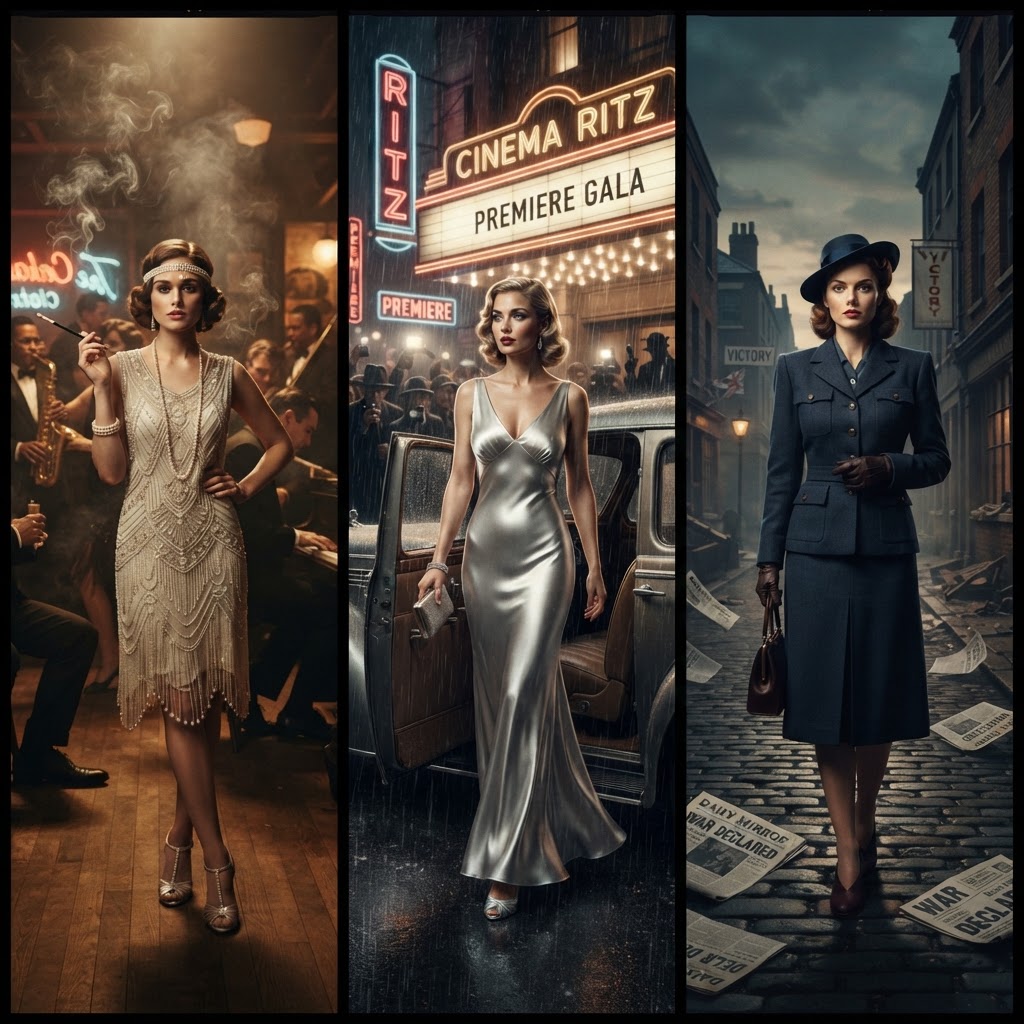
Threads of Time: What 1920s–1940s Fashion Reveals About the World We Live In Today
From the liberated silhouettes of the Jazz Age to the resourceful utility dressing of World War II, the fashion of the 1920s through the 1940s tells a story far bigger than hemlines and hat brims. These decades dressed a world in transformation—and the garments that survived are living documents of resilience, rebellion, and reinvention. Here's why the clothes of this era matter more than ever, and what they still have to say.
The Roaring Twenties: Dressing for Freedom
When the guns of World War I finally fell silent, the world exhaled—and fashion exhaled with it. The 1920s silhouette was nothing short of revolutionary. Gone were the corseted hourglass figures and floor-sweeping skirts of the Edwardian era. In their place came dropped waists, raised hemlines, and a deliberately boyish, unstructured aesthetic that fashion historians now call the "garconne" look.
But this wasn't just about aesthetics. The women who slipped into those beaded drop-waist dresses were making a statement that reverberated far beyond the dance floor. After years of wartime labor—staffing factories, driving ambulances, managing households alone—women had proven their capacity for independence. The looser, freer silhouette of the twenties was a physical manifestation of that hard-won autonomy. When a flapper cut her hair into a bob and shortened her skirt to the knee, she wasn't just following a trend. She was rewriting the social contract.
Men's fashion, too, underwent a quiet loosening. Oxford bags, wide-legged trousers that swayed as their wearers walked, became fashionable among young men who wanted to signal modernity and ease. The rigid formality of Victorian and Edwardian menswear softened into something more relaxed, more human.
What does this tell us today? It tells us that fashion has always been a first responder to social change. When society shifts, clothing shifts with it—often before the law, the workplace, or the family dinner table catches up.
Fabric as Protest: The Jazz Age and Cultural Cross-Pollination
The 1920s were also a crucible of cultural exchange—and not always a comfortable one. The Jazz Age took its name from African American music that had migrated north during the Great Migration, and the fashion world was not immune to this influence. Beaded fringe, syncopated rhythm in movement, the energy of the Charleston—all of these found their way into how people dressed and danced.
Yet this exchange was deeply unequal. Black artists, musicians, and designers whose creativity fueled the decade's aesthetic were systematically excluded from the mainstream fashion industry. Understanding twenties fashion fully means reckoning with that history—recognizing the cultural debt that the era's glamour owes to communities who were denied credit and access.
Today, as conversations around cultural appropriation and representation in fashion continue to evolve, the 1920s offer a vivid case study in what happens when cultural borrowing happens without acknowledgment. Vintage collecting, done thoughtfully, invites us to ask these questions every time we hold a garment in our hands.
The 1930s: Depression-Era Elegance and the Art of Making Do
If the twenties were a party, the 1930s were the morning after—and then some. The Great Depression reshaped fashion with brutal efficiency. Luxury became complicated, frivolity felt tone-deaf, and yet the desire for beauty didn't disappear. If anything, it intensified.
Bias-cut gowns, popularized by designer Madeleine Vionnet and made iconic by Hollywood stars like Jean Harlow and Greta Garbo, defined the decade's aesthetic. Cut diagonally across the fabric grain, these dresses clung to the body in a way that was simultaneously economical—using minimal fabric—and devastatingly glamorous. It was a decade that proved you don't need excess to achieve elegance.
Hollywood played an enormous role here. As unemployment soared and breadlines stretched around city blocks, movie palaces offered escape—and the silver screen silhouette gave ordinary people something aspirational to emulate on a budget. Women learned to sew their own versions of what they saw on screen, developing skills and resourcefulness that would serve them in the decade to come.
The 1930s remind us that style is not the exclusive province of abundance. Some of the most enduring design innovations in history were born from constraint. When you wear a beautifully preserved bias-cut dress from this era, you're wearing proof of that truth.
The 1940s: Utility, Sacrifice, and the Politics of the Wardrobe
No decade in modern history politicized clothing more directly than the 1940s. With World War II consuming resources across the globe, governments stepped directly into the wardrobe. In Britain, the Utility Clothing Scheme of 1941 imposed strict limits on fabric usage—no double cuffs, no patch pockets, no decorative stitching. In the United States, War Production Board Regulation L-85 similarly restricted hemlines, fullness, and the use of wool and silk.
And yet, fashion found a way. Women's suits became sharply tailored with padded shoulders, projecting strength and competence at a time when women were once again flooding into the workforce. The victory roll hairstyle kept hair practical and off the face while reading as polished and put-together. Creativity flourished within restriction—a lesson that designers from Alexander McQueen to Vivienne Westwood have cited as foundational to their own philosophies.
Men's fashion largely disappeared into uniform, which created its own powerful visual language. The silhouette of the military uniform—structured shoulders, tapered waist, strong lines—filtered into civilian dress and remained influential for decades afterward.
Meanwhile, in a painful counterpoint, the zoot suit—an extravagantly full-cut suit worn primarily by Black and Latino young men—became a flashpoint for racial tension. The suits deliberately flouted wartime fabric restrictions, and in 1943, they sparked the Zoot Suit Riots in Los Angeles, in which servicemen attacked zoot suit wearers on city streets. The garment had become a symbol of defiance, and defiance was met with violence. Here again, fashion and politics were inseparable.
What These Decades Tell Us Now
Looking at 1920s–1940s fashion from the vantage point of the present, several powerful themes emerge.
First, fashion is never apolitical. Every hemline, every silhouette, every fabric choice exists within a social and political context. When we engage with vintage clothing, we're engaging with history in one of its most intimate and tactile forms.
Second, constraint breeds creativity. Some of the most beautiful and enduring garments in fashion history were made during periods of profound limitation—economic depression, wartime rationing, social restriction. The ingenuity baked into these garments is part of what makes them worth preserving.
Third, clothing carries identity. Whether it was the flapper asserting her independence, the Hollywood-inspired seamstress finding beauty in hard times, or the zoot suiter refusing to be erased, people in these decades used clothing to say I am here, and I matter. That impulse hasn't changed.
Fourth, sustainability is not new. The mend-and-make-do ethos of the 1930s and 1940s is something the modern fashion industry is only just beginning to rediscover. Vintage clothing is, by definition, sustainable fashion—and the garments of this era were built to last in ways that fast fashion cannot match.
Bringing History Home with Ensemble
At Ensemble, we believe that every vintage piece is a primary source—a document of the life, the era, and the hands that made and wore it. Our marketplace features carefully authenticated clothing from the 1920s through the 2010s, with a deep and lovingly curated selection from these transformative interwar and wartime decades.
When you shop Ensemble, you're not just finding a beautiful garment. You're becoming a steward of history, a participant in a story that began long before you and will continue long after. Whether you're drawn to the beaded glamour of a Jazz Age evening dress, the sharp utility of a 1940s women's suit, or the bias-cut poetry of a Depression-era gown, you'll find it here—authenticated, contextualized, and ready for its next chapter.
The past dressed itself with intention. It's time we did the same.