The Art of Building a Timeless Capsule Wardrobe with Authentic Vintage Pieces
Forget fast fashion's endless churn — the most sophisticated wardrobes are built slowly, intentionally, and with pieces that have already proven their staying power. A vintage capsule wardrobe isn't just an aesthetic choice; it's a philosophy. Here's how to curate one that spans decades without losing coherence.
What Is a Vintage Capsule Wardrobe, and Why Does It Matter?
The concept of the capsule wardrobe was popularized in the 1970s by London boutique owner Susie Faux, who advocated for a small collection of timeless, high-quality essentials that could be mixed, matched, and worn season after season. Decades later, the idea feels more urgent than ever. With fast fashion producing billions of garments annually — most destined for landfill within a year — building a wardrobe from authentic vintage pieces is both a stylish act of resistance and a deeply practical one.
A vintage capsule wardrobe differs from a conventional one in one crucial way: every piece carries history. A 1940s wool blazer didn't survive eighty years by accident. It was made well, cared for, and cherished. When you bring it into your closet, you're inheriting that legacy — and committing to continue it.
Start with a Decade Anchor, Not a Decade Obsession
One of the most common mistakes new vintage collectors make is trying to dress head-to-toe in a single era. While a fully committed 1950s ensemble has its place on the runway or at a themed event, day-to-day wearability demands a more fluid approach. Instead, choose a decade anchor — the era whose silhouettes, fabrics, and proportions most flatter your body and reflect your personality — and build outward from there.
Love the clean lines and power shoulders of the 1980s? Use that as your structural foundation, then soften it with a fluid 1970s blouse or a minimalist 1990s slip dress layered underneath. Drawn to the romance of the 1930s bias cut? A satin slip skirt from that era pairs beautifully with a modern-feeling 1960s mod jacket. The goal is cohesion through personal vision, not chronological accuracy.
The Core Pieces Every Vintage Capsule Needs
Regardless of your anchor decade, certain categories of vintage clothing serve as the backbone of a functional, versatile wardrobe:
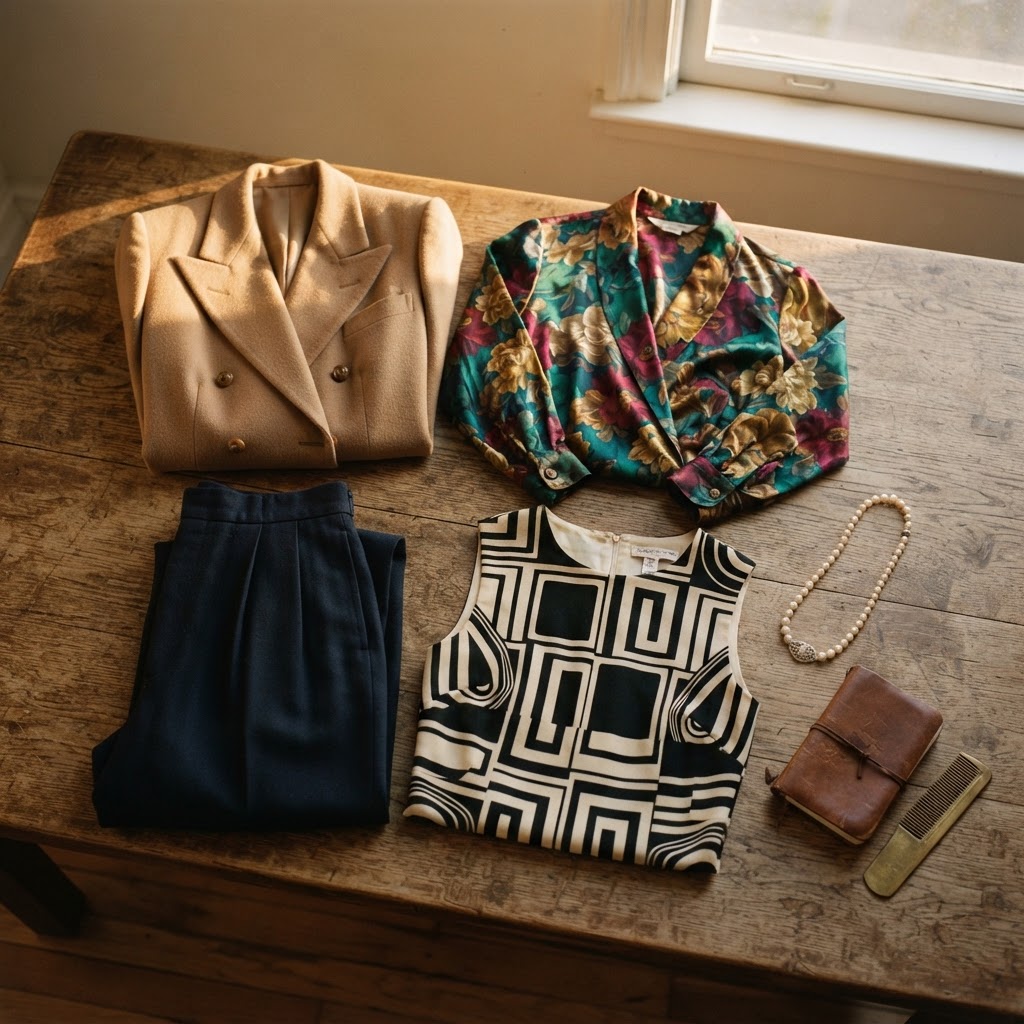
1. The Tailored Blazer or Jacket Few garments are as universally transformative as a well-cut blazer. A 1940s single-breasted wool jacket brings structure and gravitas. A 1970s velvet blazer adds bohemian richness. A 1990s oversized double-breasted coat delivers effortless cool. Invest in one exceptional blazer and treat it as your wardrobe's cornerstone.
2. High-Waisted Trousers High-waisted trousers have appeared in virtually every decade from the 1930s onward, which makes them one of the easiest vintage items to integrate into a modern wardrobe. Look for 1940s wide-leg trousers in gabardine or crepe, or 1970s flared styles in earthy tones. The cut elongates the silhouette and pairs with almost anything.
3. The Printed Blouse or Shirt This is where personality enters the picture. A 1950s novelty-print cotton blouse, a 1960s geometric Pucci-inspired top, or a 1970s wrap blouse in a bold floral — these pieces do the talking so the rest of your outfit doesn't have to. Choose prints that feel authentically you, not just authentically vintage.
4. A Statement Dress Every capsule wardrobe deserves one dress that stops the room. Whether it's a 1920s beaded flapper silhouette, a 1950s full-skirted party dress, or a sleek 1960s shift, this is the piece you save for moments that deserve more than the ordinary.
5. Outerwear with Longevity Authentic vintage coats — particularly those from the 1950s through the 1970s — were constructed with a weight and craftsmanship that modern outerwear rarely matches. A camel hair coat, a brocade evening jacket, or a structured trench from this era will outlast anything produced today.
6. Foundational Knitwear Soft, neutral, and endlessly versatile, vintage knitwear — think 1960s twin sets, 1970s turtlenecks, or even a beautifully preserved 1980s oversized sweater — grounds louder pieces and keeps your wardrobe seasonally adaptable.
How to Shop Vintage with Intention
Building a capsule wardrobe from vintage pieces requires a different mindset than conventional shopping. Here are the principles that separate impulsive vintage collecting from intentional vintage curation:
Buy condition, not just era. A stunning 1930s gown with significant damage is not a wardrobe asset — it's a restoration project. Unless you have the skills and resources to repair it, prioritize pieces in excellent or very good condition. Look for strong seams, intact closures, no moth damage, and stable fabric.
Understand your measurements — and vintage sizing. Vintage sizing is notoriously inconsistent. A labeled size 12 from 1955 may fit like a modern size 6. Always measure the actual garment dimensions and compare them to your own measurements before purchasing, especially when buying online.
Prioritize natural fibers. Wool, silk, cotton, and linen not only feel better against the skin — they also age more gracefully, respond better to alterations, and are far more durable than synthetics. When you find a 100% wool 1940s coat or a pure silk 1970s blouse, you're looking at a piece built to last another fifty years with proper care.
Think in outfits, not pieces. Before committing to a purchase, ask yourself: what three things in my existing wardrobe does this pair with? If you can't answer easily, the piece may not earn its place in a capsule wardrobe, no matter how beautiful it is.
Caring for Your Vintage Investment
Authentic vintage clothing requires more attentive care than modern garments, but the effort is minimal compared to the reward. Store wool and silk in breathable garment bags away from direct light. Use cedar blocks rather than mothballs to protect natural fibers. Dry clean sparingly — over-cleaning degrades fabric over time. For daily freshening, a fabric steamer is gentler and more effective than ironing for most vintage textiles.
Learn basic hand-stitching for small repairs. A loose button or a minor hem can often be fixed in minutes at home, extending the life of a piece indefinitely. Treat your vintage wardrobe the way its original owners did: with respect, patience, and care.
Mixing Decades Like a Stylist
The true art of vintage dressing lies in the unexpected combination. Some pairings that consistently work across eras:
- A 1920s beaded camisole tucked into 1970s wide-leg trousers — the contrast of delicate and relaxed creates effortless elegance.
- A 1960s mod mini skirt worn with a 1980s oversized blazer — structured volume on top balances the abbreviated hemline.
- A 1950s full skirt styled with a 1990s fitted crew-neck sweater — the decade clash reads as refreshingly modern rather than costume-like.
- A 1940s tailored jacket over a 2000s slip dress — the structured menswear piece grounds the feminine softness beneath it.
The common thread in all these combinations? Proportion and intention. When every piece is chosen thoughtfully, the decades stop competing and start conversing.
Conclusion: Building Something That Lasts
A vintage capsule wardrobe is, at its heart, an act of optimism — a belief that beautiful things are worth preserving, that quality outlasts trends, and that style is more interesting when it carries a story. Unlike the throwaway culture that dominates modern retail, every piece you add from the authentic vintage market represents a commitment to wearing something that has already earned its place in history.
At Ensemble, we've spent years sourcing authentic vintage clothing from the 1920s through the 2010s, so that every piece you find has been vetted for authenticity, condition, and wearability. Whether you're anchoring your capsule in the glamour of the 1940s or the irreverence of the 1990s, Ensemble is where your wardrobe's next great chapter begins. Shop intentionally. Dress with history. Build something timeless.