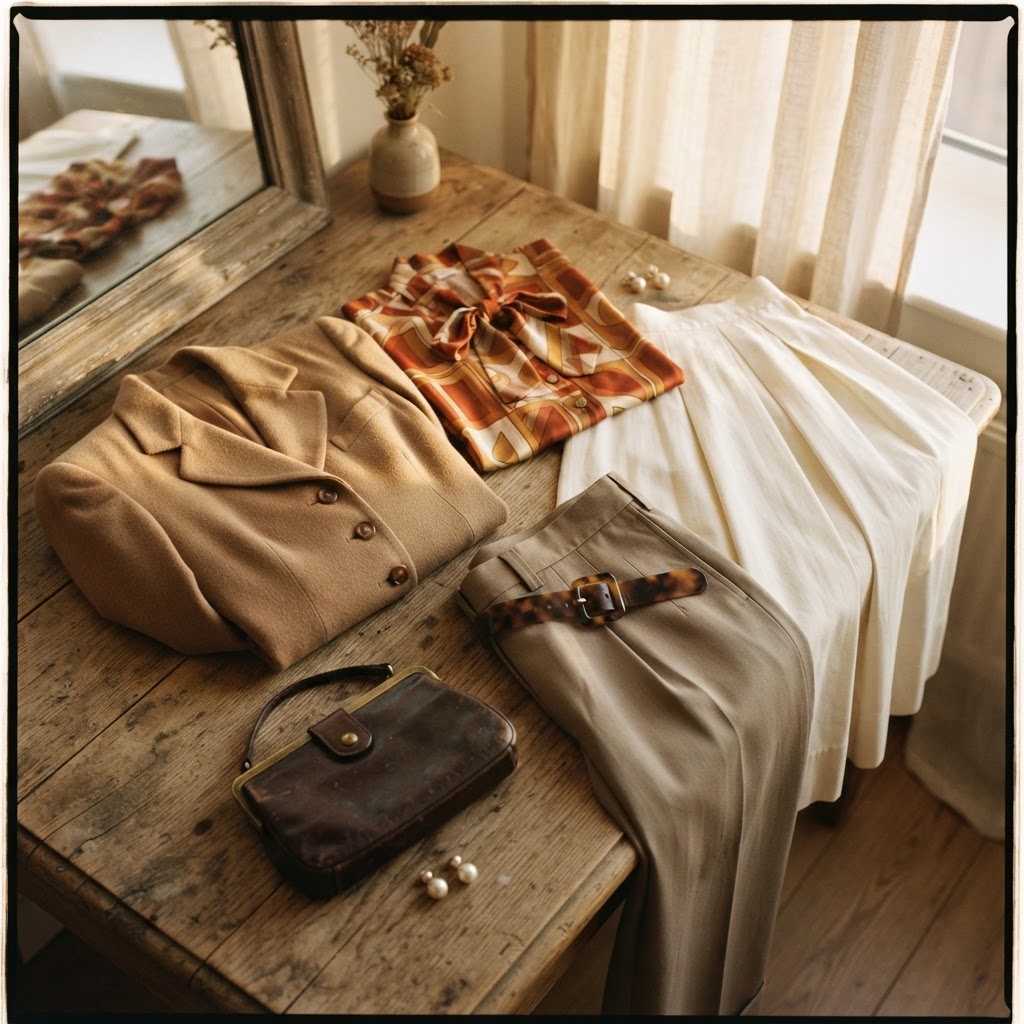
The Art of Building a Timeless Capsule Wardrobe with Authentic Vintage Pieces
Forget fast fashion's endless churn — the most sophisticated wardrobes are built on a foundation of carefully chosen authentic vintage pieces that tell a story across decades. A vintage capsule wardrobe isn't just an aesthetic choice; it's a philosophy of intentional dressing that honors craftsmanship, sustainability, and personal style. Here's how to curate yours with confidence.
What Is a Vintage Capsule Wardrobe, and Why Does It Matter?
The concept of a capsule wardrobe — a tightly edited collection of versatile, high-quality pieces that work harmoniously together — was popularized in the 1970s by London boutique owner Susie Faux. The idea was simple: own less, but own better. When you apply that philosophy to authentic vintage clothing, something magical happens. Every piece carries history, construction quality that modern manufacturing rarely matches, and a singularity that no algorithm can replicate.
Building a vintage capsule wardrobe means moving beyond trend-chasing and toward a deeply personal visual language. It means understanding which decades speak to your silhouette, your lifestyle, and your values — and then hunting deliberately for the pieces that anchor everything together.
Start with Your Decade DNA
Before you buy a single item, spend time exploring what we call your Decade DNA — the era or eras whose aesthetic feels most instinctively like you. Are you drawn to the sharp-shouldered power of 1940s tailoring? The free-spirited prints of the 1970s? The clean minimalism of 1990s suiting? You don't have to commit to one decade, but identifying your two or three anchor eras will prevent your collection from becoming a costume box and keep it feeling like a coherent wardrobe.
A useful exercise: pull inspiration images without filtering by era. Once you have thirty or forty images you love, lay them out and look for patterns. You'll likely find that certain silhouettes, fabric weights, and color stories repeat — and those repeating elements are your Decade DNA.
The Foundational Five: Building Blocks of a Vintage Capsule
Every strong vintage capsule wardrobe rests on five categories of pieces. Think of these as your load-bearing garments — everything else hangs off them.
1. The Structured Blazer or Jacket A well-constructed vintage blazer is arguably the single most versatile piece you can own. A 1960s mod wool blazer, a 1980s power-shoulder crepe jacket, or a 1950s boxy sport coat can anchor everything from denim to evening separates. Look for clean seams, quality lining, and buttons that haven't been replaced with cheaper hardware. The structure of vintage tailoring — often incorporating horsehair canvas rather than the fused interlinings common today — means these pieces hold their shape for decades more.
2. The High-Waisted Trouser or Wide-Leg Pant From 1930s palazzo trousers to 1970s flares, vintage bottoms tend to flatter a remarkable range of bodies because they were designed before the low-rise experiment of the 2000s. A neutral-toned pair in wool, gabardine, or heavyweight cotton becomes the backbone of dozens of outfits.
3. The Statement Blouse or Shirt This is where personality enters. A 1940s rayon crepe blouse with delicate pin-tuck detailing, a 1970s geometric-print secretary blouse, or a 1990s silk slip-style top — your statement blouse should feel like a conversation starter while still pairing easily with your structured bottoms.
4. The Versatile Day Dress A single, well-chosen vintage dress can serve as a standalone outfit, be layered under a blazer for work, or be belted and styled for evening. The shirtwaist silhouette of the 1950s is perennially flattering. 1960s A-line shifts work across seasons. 1970s wrap dresses in matte jersey remain among the most body-conscious and comfortable options in any wardrobe.
5. The Elevated Outerwear A vintage coat is an investment that pays dividends every time you leave the house. 1940s and 1950s wool coats in camel, charcoal, or navy are essentially indestructible. A 1960s mod coat in a bold geometric pattern makes every outfit beneath it irrelevant. Quality outerwear is where vintage truly outperforms contemporary options at almost every price point.
Understanding Fabric and Construction Quality
One of the greatest advantages of authentic vintage clothing is material integrity. Prior to the widespread adoption of synthetic blends in the 1980s and fast-fashion manufacturing in the 1990s, garments were routinely made from pure wool, silk, cotton, rayon, and linen — natural fibers that breathe, age beautifully, and can be tailored and repaired. Learning to identify fabric content by touch and by label is a skill that transforms your vintage shopping.
Check for French seams (a seam enclosed within a seam, with no raw edges visible), hand-stitched hems, bound buttonholes (a hallmark of quality tailoring through the 1960s), and full linings in jackets and skirts. These construction details indicate a garment built to last — and they're increasingly rare in contemporary clothing.
Color Strategy: Mixing Decades Without Looking Costumey
The fear most people have about wearing vintage is looking like they're in a costume. The antidote is a disciplined color strategy. Build your capsule around a core palette of three to four neutrals — think ivory, camel, navy, and black — and allow prints and statement pieces to be your accent layer. This way, a 1950s circle skirt in a novelty print reads as intentional style rather than Halloween, because it's grounded by a neutral blazer and simple footwear.
Mixing decades works best when you mix silhouettes, not entire looks. Pair a 1930s-cut bias blouse with straight-leg contemporary trousers, or wear a 1980s oversized blazer with slim modern denim. The vintage piece becomes the focal point; the modern piece anchors it in the present.
Care, Storage, and the Long Game
A vintage capsule wardrobe is a living collection that requires thoughtful stewardship. Store woolens and silks in breathable garment bags with cedar rather than mothballs. Hang structured jackets on wide, padded hangers that preserve shoulder shape. Fold knits rather than hanging them to prevent stretching. For cleaning, always default to the most gentle option — hand washing in cool water or professional dry cleaning for structured pieces.
Think of your capsule as a long game. Add one or two deliberate pieces per season rather than shopping reactively. Keep a wish list of the specific silhouettes and decades you're missing, and shop against that list. Over three to five years, you'll have assembled something genuinely rare: a wardrobe with coherence, quality, and a point of view.
Where Intentionality Meets Discovery
The most rewarding aspect of building a vintage capsule wardrobe is that it demands you become a student of fashion history. You begin to understand why the New Look of 1947 felt so revolutionary after wartime fabric rationing. You notice how 1990s minimalism was a direct reaction to the maximalism of the decade before it. Each piece you add teaches you something, and that knowledge makes you a more discerning, more confident dresser.
Conclusion: Your Wardrobe, Your Archive
A vintage capsule wardrobe is ultimately an archive of human creativity — proof that great design transcends trend cycles and that quality endures. It's also one of the most sustainable approaches to dressing available to us, extending the life of garments that already exist rather than demanding new production.
At Ensemble, we believe that every authentic vintage piece deserves to find its next chapter. Whether you're sourcing your foundational blazer, hunting for the perfect 1970s wrap dress, or finally committing to that statement coat, our marketplace is curated to help you build deliberately and dress beautifully. Browse the decades, trust your instincts, and start building the wardrobe that lasts a lifetime.