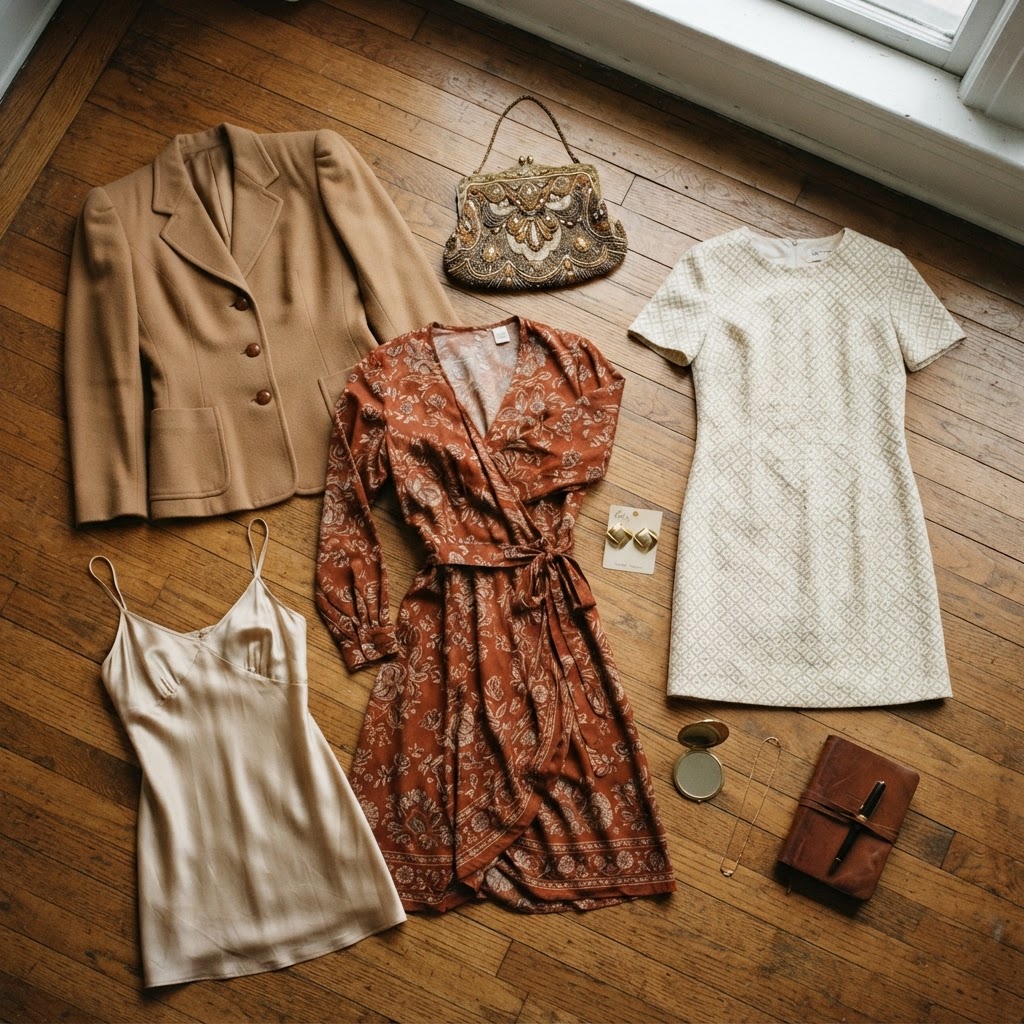
The Art of Building a Timeless Capsule Wardrobe with Authentic Vintage Pieces
Forget fast fashion's endless churn — the most sophisticated wardrobes are built on a foundation of carefully chosen authentic vintage pieces that tell a story across decades. A vintage capsule wardrobe isn't just about style; it's about intention, quality, and the thrill of wearing history. Here's how to curate yours with confidence.
What Is a Vintage Capsule Wardrobe, and Why Does It Matter?
The concept of a capsule wardrobe was popularized in the 1970s by London boutique owner Susie Faux, who argued that a small collection of high-quality, versatile pieces could outperform a closet stuffed with disposable trends. Fast-forward to today, and that philosophy has never felt more urgent — or more exciting — when applied to authentic vintage clothing.
A vintage capsule wardrobe operates on the same principle: fewer pieces, more intentionality, and a commitment to quality that mass-produced garments simply cannot match. When you invest in an authentic 1940s gabardine blazer or a perfectly cut 1970s wrap dress, you're not buying something that will pill after three washes. You're acquiring a survivor — a garment that has already proven its staying power across decades.
The goal isn't to costume yourself in a single era. The magic of a vintage capsule wardrobe lies in cross-decade dressing: pairing a 1960s mod shift dress with 1990s minimalist accessories, or anchoring a 1950s full skirt with a contemporary blouse. When done thoughtfully, the result feels effortlessly personal rather than theatrical.
Start with the Backbone: Foundational Pieces by Decade
Every great capsule wardrobe needs a backbone — the neutral, versatile anchor pieces that everything else hangs off of. In the vintage world, certain decades reliably deliver these essentials.
The 1940s and 1950s are your go-to sources for structured tailoring. Look for high-waisted trousers, wool pencil skirts, and boxy blazers with strong shoulders. The construction quality from this era is extraordinary — hand-stitched seams, lined interiors, and natural fibers like wool crepe and silk that drape beautifully. A well-preserved 1940s blazer can function as your power layer for decades to come.
The 1960s and 1970s bring versatility in a different form. A-line shifts, tunic tops, and wide-leg trousers from this era photograph brilliantly and mix easily with modern basics. The 1970s in particular produced some of the most wearable vintage pieces available today — earthy-toned wrap dresses, suede jackets, and fluid blouses that feel perpetually current.
The 1980s and 1990s offer perhaps the easiest entry point for vintage beginners. Oversized blazers, silk slip dresses, minimalist turtlenecks, and relaxed denim from these decades require almost no styling effort — they simply slot into contemporary wardrobes because they never really left. The 1990s minimalism of designers like Donna Karan and Calvin Klein translates directly into the pared-back aesthetic dominating runways today.
The Rule of Five: Building Your Vintage Capsule
When curating a vintage capsule, resist the urge to collect indiscriminately. Instead, apply the Rule of Five: anchor your collection around five core categories, sourcing the best possible version of each from the vintage market.
-
The Statement Outerwear Piece — A 1960s camel coat, a 1970s shearling jacket, or a 1950s swing coat. Outerwear from these decades was built to last and designed with an architectural boldness that modern fast-fashion coats simply mimic.
-
The Elevated Trouser or Skirt — High-waisted wool trousers from the 1940s or a 1970s flared jean. The cut of vintage bottoms tends to be more flattering for a wider range of body types than their contemporary counterparts, with higher rises and more considered proportions.
-
The Silk or Satin Blouse — A 1930s bias-cut silk blouse or a 1980s pussy-bow charmeuse top. Silk blouses from earlier decades were made from heavier, more lustrous silk than what's commonly available today. They photograph like liquid and elevate everything they're paired with.
-
The Versatile Day Dress — A 1950s cotton shirtwaist for warm months, or a 1970s jersey wrap for year-round wear. The day dress is the workhorse of any capsule wardrobe, and vintage versions offer unparalleled variety in print, silhouette, and fabrication.
-
The Statement Accessory — A 1920s beaded evening bag, a pair of 1960s mod earrings, or a 1980s sculptural belt. Vintage accessories carry enormous styling power at a fraction of the cost of vintage clothing, and they're often the detail that transforms an outfit from ordinary to genuinely memorable.
Caring for Your Investment: Vintage Garment Maintenance
Authentic vintage pieces require more attentive care than their modern counterparts, but the effort is minimal once you understand the basics.
Always check the fabric content before washing. Pre-1970s garments often lack care labels, so when in doubt, hand wash in cold water with a gentle detergent or take the piece to a dry cleaner who specializes in vintage textiles. Wool and silk from earlier decades can be surprisingly resilient when treated correctly, but agitation from machine washing is their enemy.
Store pieces properly. Use padded hangers for structured garments and fold knits flat to prevent stretching. Cedar blocks rather than mothballs will protect woolens without leaving an odor. For delicate beaded or embellished pieces, acid-free tissue paper and archival boxes are worth the investment.
Address minor repairs immediately. A small split seam or a loose button on a 1960s shift dress is a five-minute repair that prevents a much larger problem. Many cities have tailors who specialize in vintage alterations — finding one is as valuable as finding a great vintage source.
Authenticating Vintage: What to Look For
The vintage market, like any market for collectibles, has its pitfalls. Learning to authenticate pieces protects your investment and ensures the story you're wearing is genuinely the one you think it is.
Study union labels and care labels. In the United States, the ILGWU (International Ladies' Garment Workers' Union) label can help date a piece — different label designs were used in different eras, and reference guides are freely available online. Care labels weren't required by US law until 1971, so a garment without one is likely pre-1970s.
Examine the zipper. Metal zippers typically indicate pre-1960s manufacture. Nylon coil zippers became common in the 1960s and 1970s. A plastic molded zipper usually suggests 1980s or later.
Feel the fabric. Pre-1960s natural fibers have a weight, drape, and hand-feel that synthetics and modern blends rarely replicate. Genuine 1940s wool crepe, 1950s silk taffeta, or 1930s rayon charmeuse feel unmistakably different from contemporary versions of the same fabrics.
Cross-Decade Styling: The Real Art
The most compelling vintage capsule wardrobes aren't period costumes — they're living, evolving collections that bridge eras with intention. A 1930s silk blouse paired with 1990s wide-leg trousers and contemporary loafers isn't a contradiction; it's a conversation between decades that only the wearer can orchestrate.
Start by identifying the silhouette language that feels most natural to you. If you're drawn to structure, anchor your capsule in 1940s tailoring and supplement with 1980s power dressing. If you prefer fluidity, look to the 1930s, 1970s, and early 1990s for kindred spirits across the decades.
Color palette is your unifying thread. A capsule built around neutrals punctuated by one or two signature hues will feel cohesive even when the pieces span eighty years of fashion history. Many experienced vintage dressers find that earth tones — the ochres, tobacco browns, and forest greens that recur across nearly every decade — become the natural language of their cross-era wardrobe.
Conclusion: Where History Meets Your Wardrobe
Building a vintage capsule wardrobe is one of the most rewarding projects a fashion-conscious person can undertake. It demands patience, curiosity, and a willingness to learn — but the payoff is a wardrobe with genuine depth, extraordinary quality, and a sustainability story that no fast-fashion brand can touch.
At Ensemble, our marketplace is built around exactly this kind of intentional collecting. Whether you're sourcing your first 1950s blazer or completing a decade-spanning capsule with a rare 1920s beaded clutch, our curated selection of authenticated vintage pieces from the 1920s through the 2010s gives you the confidence to shop with purpose. Every piece on Ensemble has been vetted for authenticity, condition, and that elusive quality that makes vintage clothing worth wearing: the sense that it was made to last. Browse the collection today, and start building a wardrobe that tells your story — in every decade's voice.