The Art of Building a Timeless Capsule Wardrobe with Authentic Vintage Pieces
A capsule wardrobe isn't just a modern minimalist trend — it's a philosophy that vintage dressing has quietly championed for decades. By curating a small collection of authentic, era-defining pieces, you can build a wardrobe that is simultaneously personal, sustainable, and endlessly stylish. Here's how to do it right, one genuine vintage find at a time.
What Is a Capsule Wardrobe, Really?
The term "capsule wardrobe" was coined by London boutique owner Susie Faux in the 1970s and later popularized by Donna Karan's iconic "Seven Easy Pieces" collection in 1985. The concept is elegantly simple: a tightly edited collection of versatile, high-quality garments that work together seamlessly, reducing decision fatigue while maximizing style impact. But here's what the modern minimalism conversation often misses — vintage clothing has always embodied this philosophy naturally.
Authentic vintage pieces were built to last. The woman who purchased a 1940s wool crepe blazer or a 1960s silk shift dress wasn't buying something disposable. She was investing in craftsmanship. When you bring those same garments into your wardrobe today, you're not just buying clothes — you're inheriting intention.
Why Vintage Is the Ultimate Capsule Foundation
Fast fashion's greatest lie is the illusion of abundance. Owning 80 poorly made garments gives you fewer real options than owning 15 exceptional ones. Authentic vintage clothing cuts through that noise immediately.
Consider the construction differences alone. Pre-1980s garments were routinely made with French seams, hand-stitched hems, full linings, and natural fibers like wool, cotton, silk, and linen. These aren't just aesthetic upgrades — they mean your pieces drape better, wear better, and photograph beautifully in any era. A 1950s full-skirted day dress or a 1970s leather trench coat will anchor a capsule wardrobe in a way that a modern high-street equivalent simply cannot replicate.
Vintage also solves the uniqueness problem. One of the quiet frustrations of building a capsule wardrobe from contemporary retailers is that your "timeless" white shirt is the same white shirt worn by thousands of others. An authentic vintage piece carries singular provenance — a specific factory, a specific decade, a specific hand.
Choosing Your Anchor Decade
The first step in building your vintage capsule is identifying which decade or era speaks most naturally to your existing aesthetic sensibility. This doesn't mean you're locked into a costume — it means you're establishing a visual language for your wardrobe.
- 1920s–1930s enthusiasts gravitate toward bias-cut silhouettes, art deco embellishment, and languid elegance. Look for slip-style dresses, wide-leg trousers, and delicate beaded evening wear as statement anchors.
- 1940s–1950s dressers tend to love structure. Tailored jackets with nipped waists, A-line skirts, and crisp button-down blouses form a naturally cohesive capsule that reads as polished in virtually any context.
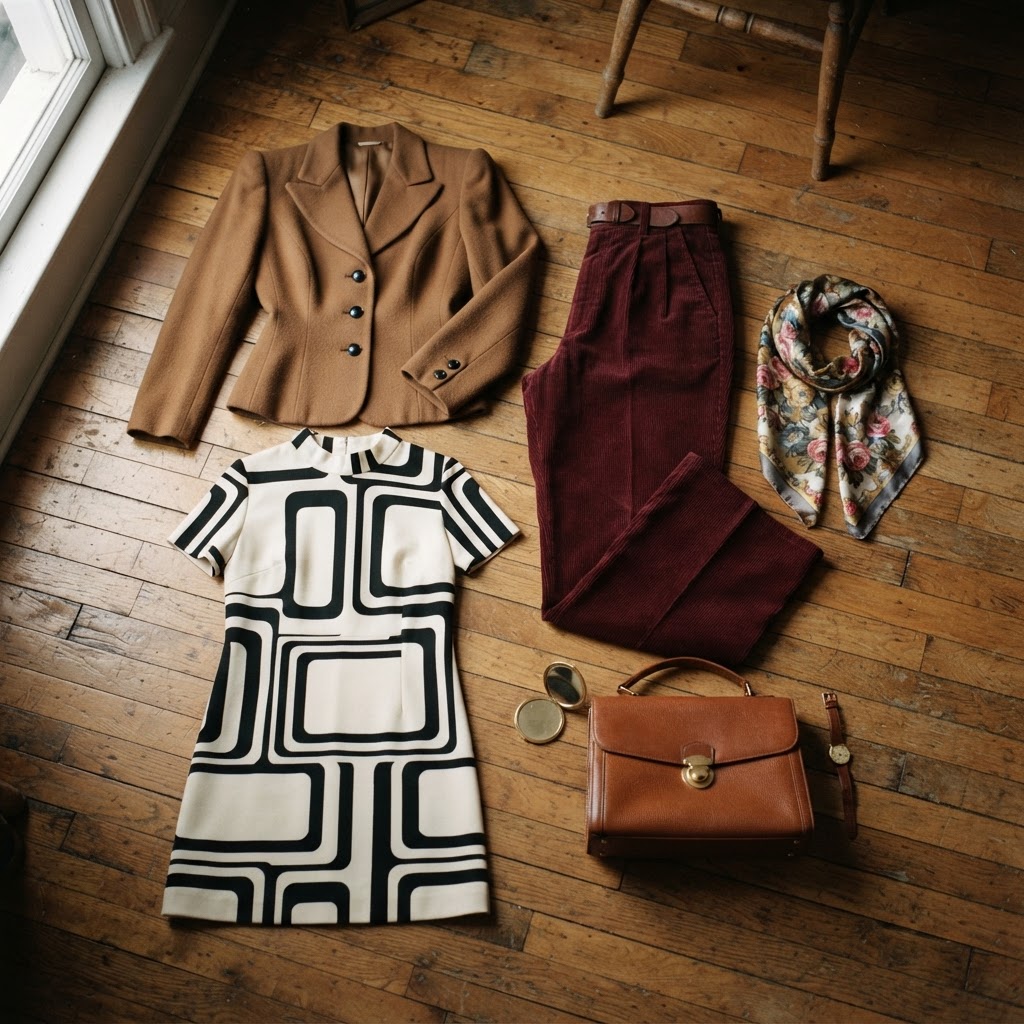
- 1960s–1970s collectors often build around bold geometry or earthy ease. Mod shift dresses, wide-lapel blazers, and high-waisted flares are endlessly wearable and mix remarkably well with modern basics.
- 1980s–1990s devotees are perhaps the most fluid, blending power-shoulder blazers, slip dresses, minimalist Calvin Klein-era separates, and grunge-informed layering into capsules that feel genuinely contemporary.
- 2000s–2010s pickers are working in an emerging vintage space where Y2K silhouettes and early-aughts minimalism are being re-evaluated with fresh eyes.
You don't need to commit to one decade exclusively. Many of the most compelling vintage wardrobes are built across two or three adjacent eras that share a tonal or structural sensibility.
The Core Pieces to Prioritize
Regardless of your chosen decade, a strong vintage capsule wardrobe typically rests on five to seven hero garments supported by a constellation of accessories and lighter pieces.
1. The Foundational Blazer or Jacket A well-tailored vintage blazer does more work per square inch of fabric than almost any other garment. A 1970s corduroy sport coat, a 1980s oversized power blazer, or a 1940s gabardine suit jacket can anchor an entire wardrobe season.
2. The Dress That Does Everything Every era produced its version of the workhorse dress. The 1960s sheath, the 1950s shirtwaist, the 1930s tea dress — find the silhouette that flatters your body and that you reach for instinctively, then build outward from it.
3. High-Quality Trousers Vintage trousers are frequently superior to modern ones in terms of fabric weight and cut. High-waisted 1970s wide-leg trousers or 1990s tailored pleated pants offer a versatility that earns their space in any capsule.
4. A Statement Outerwear Piece Coats and jackets from previous decades were often the most expensive items a person owned, meaning they were made exceptionally well. A 1960s wool princess coat or 1980s leather bomber can organize an entire seasonal wardrobe around itself.
5. Silk or Quality Blouses A handful of authentic vintage blouses — particularly those in silk, crepe, or fine cotton — provide the layering infrastructure for the rest of your capsule without demanding attention.
Caring for Your Investment
Building a vintage capsule wardrobe is only half the equation. Proper care ensures these pieces last another century, not just another season.
Always check fiber content and construction before cleaning. Most authentic vintage garments respond best to hand washing in cool water or professional dry cleaning. Invest in proper wooden or padded hangers — wire hangers distort shoulder seams over time, and that 1950s blazer deserves better. Store woolens with cedar blocks rather than mothballs, and keep silk away from direct sunlight to prevent fading.
Learn to identify and address minor repairs proactively. A loose button, a small seam separation, or a minor moth hole caught early is a ten-minute fix. Ignored, it becomes a lost garment.
Mixing Vintage with Contemporary
The most wearable vintage capsule wardrobes are rarely composed entirely of vintage pieces. The art is in the integration — pairing a 1970s silk blouse with modern straight-leg jeans, or wearing a 1940s wool skirt with a clean contemporary turtleneck. This keeps the wardrobe feeling lived-in and genuinely personal rather than costume-like.
Accessories are where vintage integration becomes almost effortlessly stylish. A 1960s structured handbag, a set of 1980s gilt earrings, or a 1950s silk scarf can transform a modern outfit into something with genuine historical texture.
The Sustainability Argument You Already Know
It bears repeating plainly: buying authentic vintage clothing is one of the most environmentally responsible choices a consumer can make. Every vintage piece purchased is one fewer garment produced, one fewer unit of water consumed, one fewer round of chemical dyeing. The circular fashion economy isn't a future aspiration — it's a present reality available to anyone willing to look for it.
But beyond the environmental calculus, there's something quietly profound about wearing clothing that has already lived. These garments have histories. They were made by specific people, in specific places, with specific care. Bringing them into your life and extending their story is an act of both style and respect.
Building Your Vintage Capsule with Ensemble
The challenge with authentic vintage has always been access — knowing where to find genuinely well-preserved, accurately described pieces from the eras you love. That's precisely what Ensemble was built to solve. Our marketplace connects you with authenticated vintage clothing spanning the 1920s through the 2010s, curated for quality, accurately dated, and presented with the detail you need to make confident decisions.
Whether you're beginning your first capsule with a single foundational blazer or refining an already sophisticated collection with a rare 1930s evening gown, Ensemble is where the search becomes a pleasure rather than a gamble. Browse by decade, by silhouette, by occasion — and start building a wardrobe that doesn't just look timeless, but actually is.