The Art of Building a Timeless Capsule Wardrobe with Authentic Vintage Pieces
In a world of fast fashion and fleeting trends, the capsule wardrobe has never felt more revolutionary — or more attainable. Building one from authentic vintage pieces isn't just a style choice; it's a statement about quality, history, and conscious consumption. Here's how to curate a collection that transcends decades and tells your unique story.
What Is a Vintage Capsule Wardrobe?
A capsule wardrobe is a curated collection of versatile, timeless pieces that work seamlessly together, minimizing clutter while maximizing style. The concept, popularized by London boutique owner Susie Faux in the 1970s and later championed by Donna Karan, has always been rooted in quality over quantity. But when you build your capsule from authentic vintage clothing, you elevate the philosophy entirely.
Vintage pieces carry something modern garments simply cannot manufacture: provenance. A 1940s wool blazer has survived decades. A 1970s silk blouse was cut by hands that understood fabric as a living material. When these pieces anchor your wardrobe, every outfit carries depth.
Why Authentic Vintage Outperforms Modern Alternatives
Before diving into the how, it's worth understanding the why. Authentic vintage clothing — pieces genuinely produced in their respective eras rather than vintage-inspired reproductions — offers several distinct advantages.
First, there is construction quality. Garments produced before the 1990s were largely made before the widespread adoption of cost-cutting fast-fashion manufacturing. A 1950s sheath dress was sewn with seam allowances generous enough for alterations. A 1960s trench coat was lined with materials built to last generations, not seasons.
Second, vintage pieces offer true originality. No algorithm determines what a 1938 crepe evening gown looks like. It exists because a designer and a seamstress made considered choices at a specific moment in history. Wearing it means no one else at the party is wearing the same thing — because no one else can be.
Third, building a vintage capsule is an act of sustainable fashion. Choosing pre-owned and pre-loved garments directly counters the environmental toll of new production. Every vintage blazer you buy is one fewer garment demanding new cotton, new dye, new shipping miles.
The Foundation: Decade by Decade Staples
A great vintage capsule doesn't need to be locked into a single era. In fact, the most compelling wardrobes mix decades intentionally, creating a personal visual language. Here's how to think about foundational pieces from each major era.
The 1940s–1950s: Structure and Femininity
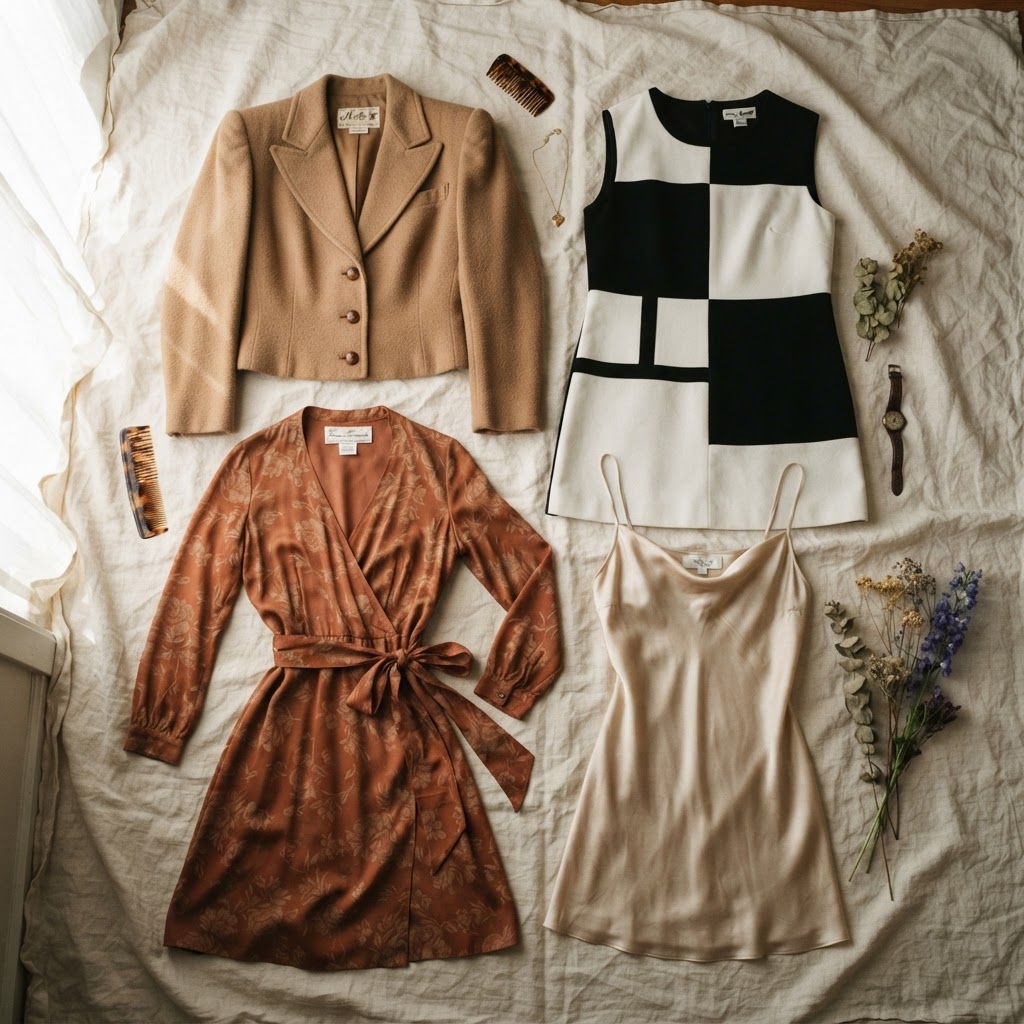
Pieces from these decades are characterized by structured silhouettes, nipped waists, and incredible tailoring. A 1940s wool suit with padded shoulders and a pencil skirt is endlessly versatile — dress it down with loafers and a simple blouse, or wear the full suit to a dinner that demands presence. 1950s full-skirted dresses in cotton or taffeta bring instant drama and photograph beautifully.
Look for: wool suits, A-line and circle skirts, structured day dresses, classic trench coats.
The 1960s–1970s: Freedom and Experimentation
These decades democratized fashion and introduced silhouettes that still feel modern. 1960s mod shift dresses in geometric prints are as wearable today as they were in Carnaby Street. From the 1970s, wide-leg trousers in earthy tones and natural fibers anchor any capsule that wants to balance casual ease with intentional style. The wrap dress, introduced by Diane von Furstenberg in 1974, remains one of the most flattering and functional garments ever created.
Look for: shift dresses, wide-leg trousers, wrap dresses, peasant blouses, bold-print maxi skirts.
The 1980s–1990s: Power and Minimalism
The 1980s gave us power dressing — oversized blazers, dramatic shoulders, and unabashedly bold color. A well-chosen 1980s blazer in camel or cobalt can transform jeans and a t-shirt into a statement. The 1990s swung toward minimalism, producing some of the cleanest, most wearable silhouettes in modern fashion history: slip dresses, clean-lined trousers, and the kind of simple knit dresses that feel effortlessly current in any decade.
Look for: oversized blazers, slip dresses, minimalist knits, high-waisted denim, leather jackets.
The 2000s–2010s: Nostalgic Currency
Now firmly in vintage territory, pieces from these decades are having a significant cultural moment. Early 2000s logomania, Y2K silhouettes, and 2010s normcore aesthetics are being reappraised with fresh eyes. A genuine early-2000s piece — not a reproduction — carries the same authenticity as any earlier era and will only appreciate in cultural value.
Look for: low-rise denim, logo pieces from heritage brands, structured handbags, clean athletic wear.
How to Build Your Capsule: A Practical Guide
Start with Neutrals and Build Outward
The golden rule of any capsule wardrobe — vintage or otherwise — is to anchor in neutrals. Black, camel, ivory, navy, and grey are the foundation. These pieces will carry the weight of your wardrobe, working across occasions and seasons. From there, introduce one or two signature colors that reflect your personal palette, then add statement pieces — a printed 1970s blouse, a beaded 1980s jacket — that elevate the whole.
Prioritize Fit Above All Else
Vintage sizing is notoriously inconsistent. A size 14 from 1955 bears no reliable relationship to a modern size 14. When shopping vintage, measure everything — bust, waist, hips, shoulder width, sleeve length — and compare to your own measurements. A piece that fits well at purchase requires no alteration budget. A stunning piece that fits poorly is a wardrobe obstacle, not an asset.
Build a relationship with a tailor who understands vintage construction. Many vintage garments were made to be altered, and skilled alterations can make an imperfect find into a perfect fit.
Think in Outfits, Not Individual Pieces
Before purchasing any vintage piece, ask yourself: what three things in my wardrobe does this work with? If you can't answer that question immediately, the piece — however beautiful — may not earn its capsule membership. The discipline of the capsule wardrobe is precisely this: intentional curation rather than impulse accumulation.
Invest in Condition and Care
Authentic vintage clothing requires mindful maintenance. Natural fibers — wool, silk, cotton, linen — dominated garment production through most of the twentieth century, and they respond well to proper care. Store woollens with cedar, hand-wash delicates, and keep silk away from prolonged sunlight. A well-maintained vintage piece will outlast any modern fast-fashion garment by decades.
The Investment Mindset
Think of your vintage capsule not as spending, but as collecting. Authenticated pieces from significant decades hold and often increase in value, particularly as the cultural appetite for genuine vintage grows stronger. The 1990s minimalist dress you purchase today may be a sought-after artifact in another twenty years.
More immediately, a thoughtfully built capsule reduces decision fatigue, cuts your overall fashion spend, and produces a wardrobe with a clear, personal point of view — something no algorithm-driven fast fashion retailer can replicate.
Conclusion: Build Your Capsule with Ensemble
Building a capsule wardrobe from authentic vintage pieces is one of the most rewarding fashion projects you can undertake. It demands patience, intention, and a genuine curiosity about the clothes that came before us. But the result — a wardrobe that is truly yours, truly sustainable, and truly timeless — is worth every considered choice.
At Ensemble, our marketplace is built for exactly this kind of intentional shopping. With authenticated vintage clothing spanning the 1920s through the 2010s, every piece has been verified for era, condition, and authenticity. Whether you're searching for the perfect 1940s blazer to anchor your capsule or a 1990s slip dress to complete it, Ensemble is where your wardrobe's next chapter begins. Browse the collection and start building something that lasts.