The Art of Building a Timeless Capsule Wardrobe with Authentic Vintage Pieces
Forget fast fashion's endless churn — the most intentional wardrobes are built one authentic vintage piece at a time. A vintage capsule wardrobe isn't just about style; it's about owning pieces with real history, real craft, and real staying power. Here's how to build yours, decade by thoughtful decade.
What Is a Vintage Capsule Wardrobe (And Why Does It Matter)?
The concept of a capsule wardrobe — a tightly curated collection of versatile, high-quality pieces that work seamlessly together — was popularized in the 1970s by London boutique owner Susie Faux. The idea was simple: own less, but own better. Decades later, that philosophy has never felt more relevant. And when you apply it to authentic vintage clothing, you get something even more extraordinary: a wardrobe that tells a story.
Building a capsule wardrobe from vintage pieces sourced across the 1920s through the 2010s isn't just a sustainable choice (though it absolutely is that). It's an act of curation, preservation, and personal expression. Every bias-cut slip dress from the 1930s, every perfectly proportioned blazer from the 1980s, every minimalist slip skirt from the 1990s carries with it the fingerprints of the era that made it — and the person who wore it before you.
The key question isn't how many pieces you own. It's whether they work together, whether they work for your life, and whether they're built to last. Vintage, by definition, has already proven the latter.
Start With a Foundation: The Timeless Anchors
Every great capsule wardrobe starts with anchor pieces — the neutral, structural items that form the backbone of dozens of outfits. In vintage, these are the pieces that transcended their own moment and became genuinely eternal.
Look for:
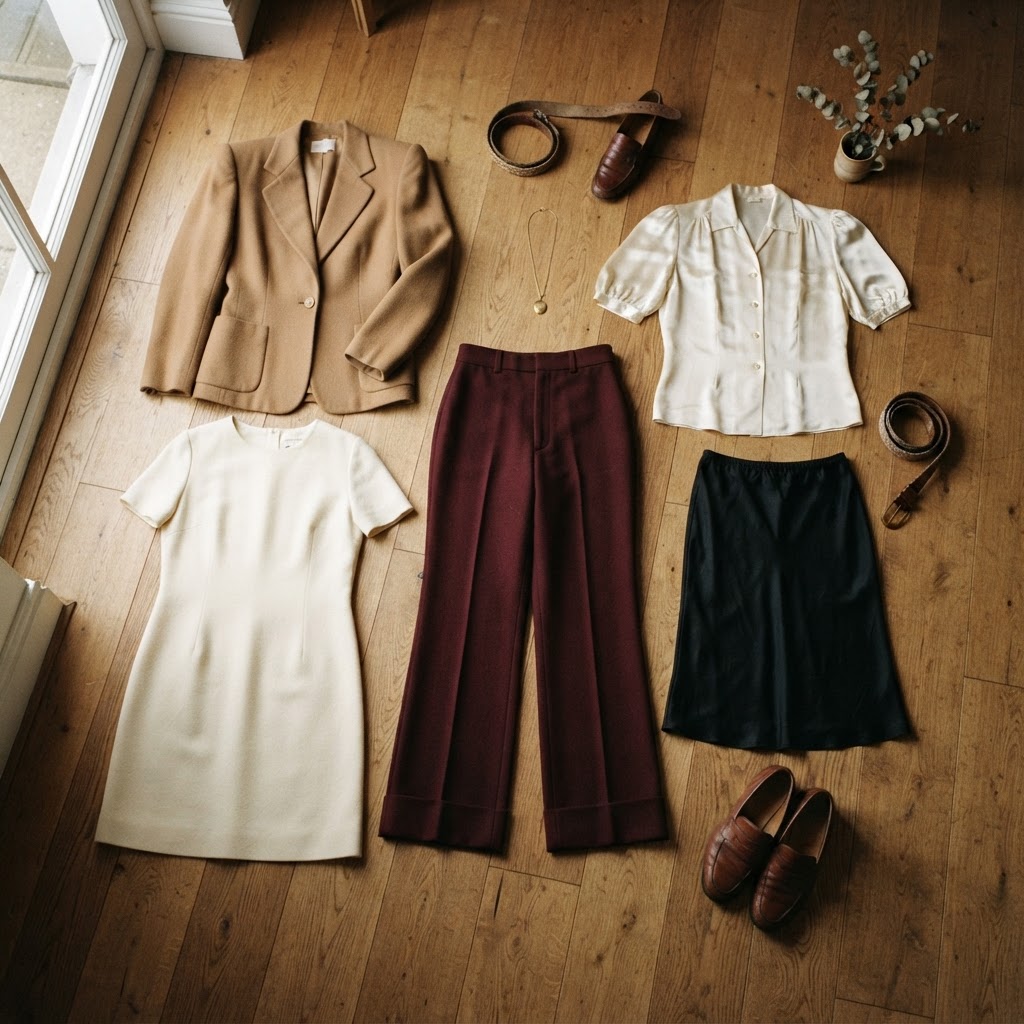
- A well-tailored blazer: The 1940s gave us structured, padded-shoulder jackets that feel powerful and modern worn with wide-leg trousers. 1970s menswear-inspired blazers in camel or cream work equally well thrown over a dress or paired with straight-leg jeans.
- A white or ivory button-down shirt: Whether it's a crisp 1960s poplin shirt or an oversized 1990s Oxford, a great white shirt is the most reliable workhorse in any wardrobe.
- Dark, straight-leg trousers: 1970s high-waisted wide-legs, 1990s flat-front cigarette pants — both silhouettes have proven their longevity.
- A little black dress: From the sleek 1960s shift silhouette to the bodycon 1990s LBD, this category spans nearly every decade in Ensemble's collection.
- A great coat: A 1960s mod wool coat, a 1970s maxi coat, or a sharp 1980s double-breasted number — outerwear from these decades was built with extraordinary craftsmanship and lasts decades more.
These five categories alone can form the skeleton of a complete wardrobe. Every piece you add afterward should be able to relate back to at least two or three of these anchors.
Layer In Decade-Specific Character Pieces
Once your anchors are in place, the real fun begins. This is where you define your aesthetic by pulling character pieces from the decades that resonate most with you.
Are you drawn to the romantic, fluid bias-cuts of the 1930s? A silk charmeuse evening blouse or a floral tea dress from that era will bring an effortless femininity to your modern blazer-and-trouser combinations. These pieces were made at a time when fabric was precious and construction was meticulous — the drape of a genuine 1930s garment is simply unmatched by any contemporary reproduction.
Do you love the clean optimism of the 1950s and 1960s? A structured shift dress, a circle skirt in a bold print, or a mod geometric top will inject graphic energy into an otherwise neutral wardrobe. These decades pioneered ready-to-wear as we know it, and many pieces from this era still feel startlingly fresh.
If your eye runs toward 1970s bohemian earthiness, a peasant blouse in cream cotton, a suede fringe jacket, or a pair of perfectly flared corduroys can become signature pieces that turn every anchor item into something more textured and personal.
And for those who love the bold confidence of the 1980s — the power shoulders, the saturated colors, the unapologetic maximalism — a single great piece like a sculptural silk blouse or an architectural knit can become the conversation-starting centerpiece of an otherwise pared-back outfit.
Think in Outfits, Not Just Pieces
One of the most common mistakes vintage shoppers make is falling in love with individual pieces without considering how they connect. A capsule wardrobe lives and dies by its internal logic.
Before buying any vintage piece, ask yourself:
- Does it work with at least three things I already own?
- Is it appropriate for at least two different contexts in my life (work, weekends, evenings)?
- Does its color palette harmonize with my existing wardrobe?
Vintage fashion has the added complexity of silhouette proportion. A voluminous 1980s blouse might need to be balanced with a streamlined trouser rather than a full skirt. A fitted 1960s shift dress might pair surprisingly well with an oversized 1990s blazer — playing with scale across decades creates some of the most interesting contemporary looks.
Building a mood board before you shop is genuinely useful here. Pull together references from each decade you're drawn to, identify where the common threads are (literally and figuratively), and shop with that visual guide in your pocket.
Quality Over Quantity: What to Look for in Authentic Vintage
Authentic vintage pieces — as opposed to vintage-inspired reproductions — bring a quality standard that modern fast fashion simply cannot replicate. But not all vintage is equal, and building a capsule wardrobe means being selective.
When evaluating vintage pieces, pay attention to:
- Construction details: Look for clean seam finishes, French seams on delicate fabrics, and even topstitching. Pre-1980s garments especially were often made with extraordinary internal craftsmanship.
- Fabric quality: Natural fibers — wool, silk, cotton, linen — age far better than synthetics. A 1940s wool coat will outlast a 1990s polyester blazer every time.
- Condition: Minor wear is expected and often charming. But structural issues — broken zippers, weakened seams, moth damage — require honest assessment of whether repair is feasible.
- Fit potential: Vintage sizing is notoriously inconsistent. Focus on shoulder width (the hardest thing to alter), and know that waist, hem, and length adjustments are relatively straightforward.
Learning to read these details transforms you from a passive shopper into an active curator — and that skill is what separates a meaningful vintage capsule from a chaotic accumulation.
The Sustainable Case for Going Vintage
Building a capsule wardrobe with authentic vintage pieces is one of the most impactful sustainable fashion choices available to modern consumers. Every vintage purchase is a garment rescued from potential waste, a vote against the extractive cycles of fast fashion, and an investment in something already proven to endure.
Beyond environmental impact, there's an economic argument: well-chosen vintage pieces hold and often increase their value. A pristine 1960s Courrèges dress or a 1970s Halston jersey wrap are not just beautiful — they are tangible cultural artifacts that appreciate over time. Your capsule wardrobe becomes, in the truest sense, a collection.
Building Your Wardrobe with Ensemble
The challenge of vintage shopping has always been access — finding the right pieces, authenticated and in wearable condition, without spending years trawling through estate sales and flea markets. That's precisely what Ensemble was built to solve.
Ensemble's marketplace brings together authentic clothing from the 1920s through the 2010s, curated with the capsule-wardrobe builder in mind. Whether you're searching for that perfect 1940s anchor blazer, a statement 1970s character piece, or a minimalist 1990s foundation item, Ensemble makes it possible to build a cohesive, intentional vintage wardrobe — one extraordinary piece at a time.
Your wardrobe is one of the most personal expressions of who you are. Make it count. Make it last. Make it vintage.