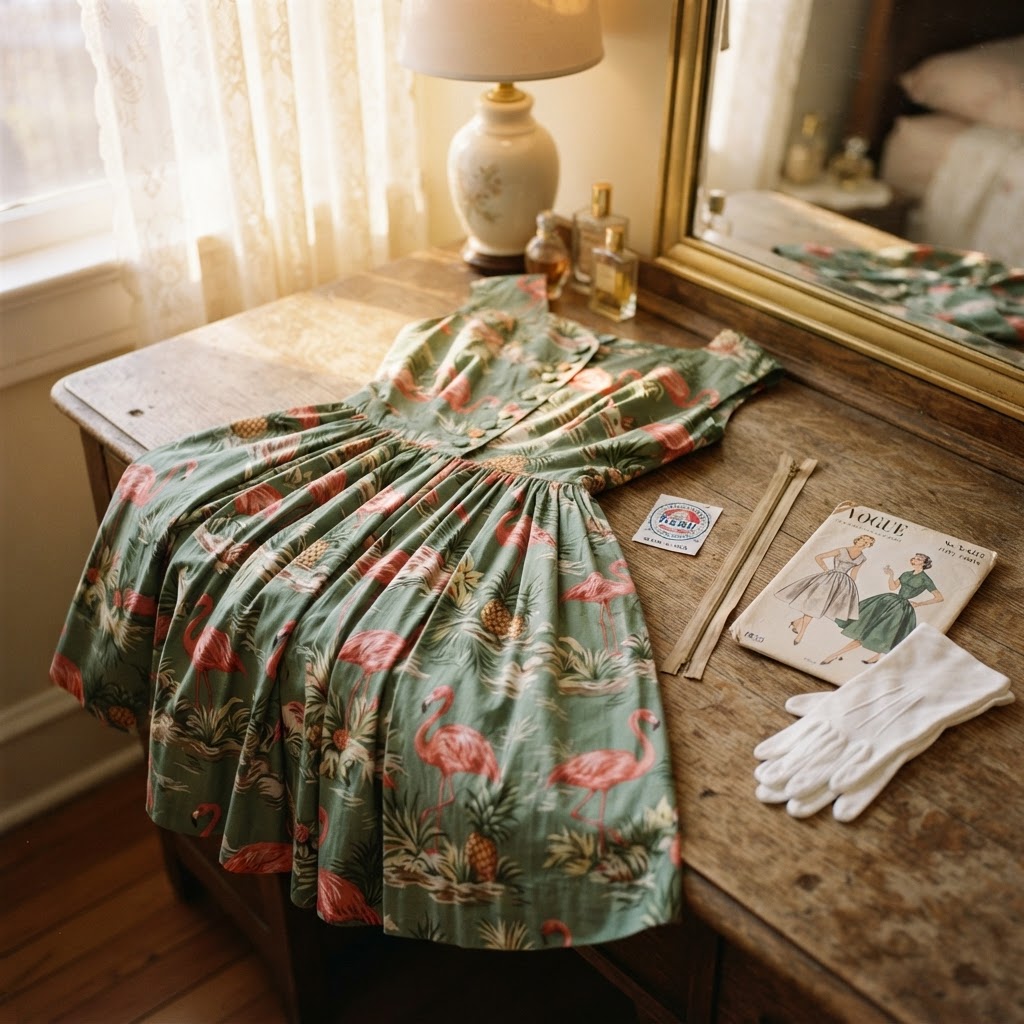
Real Deal or Repro? How to Identify Authentic 1950s Vintage Clothing vs. Modern Reproductions
The 1950s aesthetic has never really gone out of style — which means the market is flooded with modern reproductions designed to look the part. Whether you're a seasoned collector or a first-time buyer, knowing how to spot the genuine article can save you money, heartbreak, and a whole lot of buyer's remorse. Here's your definitive guide to separating true mid-century treasures from convincing copycats.
Why the 1950s Are So Easy to Fake
The 1950s remain one of the most romanticized decades in fashion history. Full circle skirts, structured bullet bras, rockabilly prints, and tailored day dresses have inspired countless revival collections from brands like Stop Stitch, Collectif, and Hell Bunny. These reproductions are not inherently bad — many are beautifully made — but they are not vintage, and they should never be priced or sold as such.
The challenge for buyers is that reproduction makers have gotten extraordinarily good at their craft. Distressed labels, period-inspired prints, and even deliberately "aged" fabrics make the modern knock-off harder to detect at a glance. But look closely, and authentic 1950s garments will always tell their own story.
Start With the Label
The care label is your single most reliable first checkpoint. Here's the golden rule: if a garment has a care label with washing or dry-cleaning symbols, it is not from the 1950s. The Federal Textile Fiber Products Identification Act wasn't passed until 1960, and mandatory care labeling in the U.S. didn't become law until 1971. A true 1950s piece will either have no care label at all, or a simple woven label listing only the brand name and perhaps the country of origin.
Also examine the union label. Many American-made garments from the 1950s carry labels from the International Ladies' Garment Workers' Union (ILGWU) or the Amalgamated Clothing Workers of America. The ILGWU label design changed over the decades, and collectors have documented these changes precisely — a quick cross-reference against a union label dating guide can tell you a lot. The classic ILGWU "Look for the Union Label" script didn't appear until the 1970s, so if you see that phrase on a supposed 1950s piece, walk away.
Country of origin labeling also shifted significantly. "Made in USA" without further qualification is period-appropriate. Labels reading "Made in China" or other modern manufacturing hubs are an immediate red flag for anything claimed to be pre-1960.
Feel the Fabric
The fiber content of a garment can be just as telling as its label. The 1950s were a transitional era for synthetics — nylon had arrived, rayon was widely used, and early polyester (Dacron) appeared toward the very end of the decade. However, the blended performance fabrics common today — stretchy ponte knits, modern spandex blends, or ultra-smooth polyester — did not exist in mid-century wardrobes.
Authentic 1950s fabrics tend to feel distinctly different from modern reproductions:
- Cotton will feel heavier and less uniform than modern cotton
- Rayon from this era has a distinctive drapey weight and slight sheen
- Wool suiting feels dense and tightly woven compared to lighter modern blends
- Nylon stockings and linings feel finer and less elastic than modern nylon
If a fabric feels impossibly wrinkle-resistant, has a noticeable stretch, or feels uniformly "perfect," it's almost certainly modern. Genuine vintage fabrics have character — slight irregularities in weave, a softness that comes from decades of gentle washing, and sometimes the faintest hint of age.
Examine the Construction
Mid-century garment construction reflects the craftsmanship standards of a pre-fast-fashion world. Here's what to look for:
Zippers are one of the clearest dating tools. Authentic 1950s garments use metal zippers, almost universally. Look for the brand name "Talon" or "Conmar" stamped on the zipper pull — these were the dominant American zipper manufacturers of the era. Nylon coil zippers (the kind with interlocking plastic teeth) weren't widely used until the 1960s. An invisible zipper on a claimed 1950s dress is a certain reproduction.
Seam finishing tells another part of the story. Home-sewn and couture garments from the 1950s often feature pinked seams (cut with pinking shears to prevent fraying), hand-overcast edges, or bound seams with bias tape. The serged (overlocked) seam edge that dominates modern construction was not standard in the 1950s. If every seam inside a garment is cleanly serged, you're likely looking at a reproduction.
Stitching density also differs. Vintage machines often produced slightly longer stitch lengths than modern industrial sewing equipment. Additionally, hand-finishing details — hand-stitched hems, hand-sewn hooks and eyes, or hand-applied trim — are signs of authentic vintage quality that modern mass production rarely replicates.
Look at the Silhouette and Sizing
This is where many buyers get caught off guard. Vintage sizing runs dramatically smaller than modern sizing. A dress labeled "Size 14" from the 1950s will typically fit a modern size 6 or 8. If a garment labeled as 1950s fits like a contemporary size medium right off the rack, that's a significant red flag.
Authentic 1950s silhouettes also reflect the structural underpinnings of the era. Boning, interfacing, and built-in structure are common in authentic pieces — many dresses were essentially their own foundation garment. Look for stiff bodices, boned waistlines, and structured shelf busts. Modern reproductions sometimes include these elements, but they tend to feel lighter and more comfortable by design.
The hemline of a true 1950s dress will typically fall below the knee — usually mid-calf or just below. The "50s style" mini dress is entirely a modern invention.
Assess the Print and Color
Textile printing technology has changed enormously since the 1950s. Authentic mid-century printed fabrics tend to show slight registration imperfections — tiny misalignments in the repeat pattern that result from the mechanical printing methods of the time. Colors may also appear slightly muted or "faded into" each other at the edges.
Modern reproductions, even high-quality ones, are printed with digital or advanced rotary screen technology, resulting in hyper-precise, perfectly registered patterns with clean, sharp color boundaries. If a novelty print looks almost photographic in its precision, it's almost certainly modern.
The color palette can also be a subtle indicator. 1950s dyes produced specific shades — dusty pinks, sage greens, mustard yellows, and coral tones that have a particular vintage quality. Neon brights and certain high-saturation hues common today simply weren't achievable with mid-century dye technology.
When in Doubt, Ask for Provenance
Reputable vintage sellers should be able to provide some context for their pieces — where the item was sourced, how it was dated, and what details support its authenticity. Provenance isn't always available for vintage clothing the way it is for art or antiques, but a seller who can speak knowledgeably about a garment's label history, fabric composition, and construction details is a seller worth trusting.
Be cautious of listings that use vague language like "vintage-inspired," "vintage-style," or "retro" — these are often codes for reproduction. Authentic vintage listings should state clearly that the piece is an original from the period.
Shop With Confidence at Ensemble
At Ensemble, every listing on our marketplace goes through a careful authentication review before it reaches you. Our community of sellers specializes in authentic clothing from the 1920s through the 2010s, and our team takes decade-accurate dating seriously. When you shop a 1950s piece on Ensemble, you're getting the real thing — the genuine mid-century craftsmanship, the original fabric, and the irreplaceable history that no reproduction can replicate. Browse our curated 1950s collection today and find your authentic piece of the past.