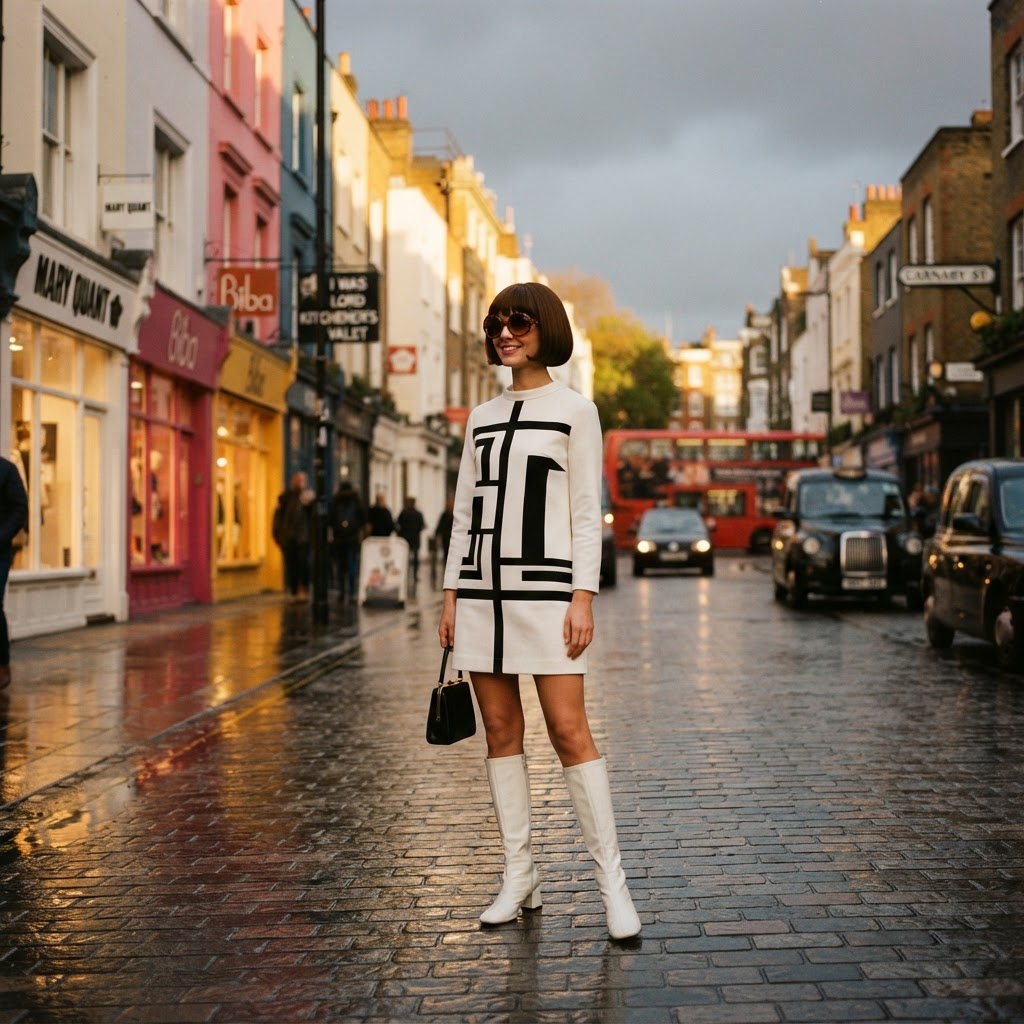
Mod Squad: The Story Behind 1960s Mod Fashion and Its Enduring Legacy
Few style movements have left as vivid a mark on fashion history as the mod revolution of the 1960s. Born on the streets of London and amplified by pop culture, mod fashion shattered the rules of post-war dressing and rewrote them in bold geometry and electric color. Decades later, its DNA is woven into everything from high-fashion runways to the vintage pieces collectors hunt today.
A Revolution Stitched in London
To understand mod fashion, you have to understand the world it rebelled against. In the late 1950s, Western clothing was still largely governed by the stiff, structured silhouettes that had dominated since the war years — pencil skirts, full petticoats, and conservative cuts that telegraphed propriety above all else. Then came the 1960s, and with it, a generation of young Britons who had no interest in dressing like their parents.
The epicenter of this revolt was a single street: Carnaby Street in London's Soho neighborhood. By the early 1960s, it had transformed from an unremarkable backstreet into a neon-lit runway for the new youth culture. Boutiques like John Stephen's His Clothes and, slightly to the west, Mary Quant's Bazaar on the King's Road became temples to a radical new aesthetic. These weren't department stores catering to mature women — they were playgrounds for young people who wanted fashion that felt alive.
The word "mod" itself derived from "modernist," a term originally used to describe young jazz and R&B enthusiasts in the late 1950s who prized sharp Italian suits, scooters, and a certain cool intellectual edge. By the mid-1960s, the term had expanded to describe an entire visual and cultural movement that was anything but understated.
The Defining Elements of Mod Style
What made mod fashion so instantly recognizable — and so revolutionary — was its fearless embrace of geometry, minimalism, and the future. Where previous decades had romanticized the curves of the feminine silhouette, mod design celebrated the A-line shift dress: a simple, unstructured shape that grazed the thighs and allowed the body to move freely. It was democratic, youthful, and deeply modern.
Colors went bold or went home. Op art-inspired prints — think graphic black-and-white checks, bold stripes, and geometric tessellations — dominated fabric design, influenced heavily by artists like Bridget Riley. Alongside these, saturated solids in tangerine, electric blue, lime green, and canary yellow made a visual statement from across the room.
Perhaps no single garment defined the era more than the miniskirt. Though the precise origin is still debated between Mary Quant and French designer André Courrèges, there's no question that it became the ultimate symbol of 1960s liberation. Hemlines climbed several inches above the knee, and in doing so, they transformed fashion into a political act — a declaration of bodily autonomy and generational independence.
Footwear matched the drama. Go-go boots — white, low-heeled, and knee-high — became a staple, as did block-heeled Mary Janes in patent leather. Accessories leaned futuristic: oversized round sunglasses, geometric earrings, and the iconic Vidal Sassoon five-point haircut that framed a face with architectural precision.
For men, mod fashion was equally transformative. Slim-cut suits in bold patterns, turtleneck sweaters, Chelsea boots, and nehru-collar jackets replaced the boxy cuts of the previous decade. Bands like The Beatles and The Kinks were as much style icons as they were musical ones, their wardrobes broadcast globally through television and album covers.
The Icons Who Defined the Look
No conversation about mod fashion is complete without Twiggy. Born Lesley Lawson in London in 1949, she became the decade's defining face — literally. Her doe eyes, cropped hair, and willowy frame embodied the mod ideal, and her influence on modeling and fashion remains unmatched. She didn't just wear mod clothes; she was mod fashion made flesh.
Mary Quant herself deserves equal billing as both designer and icon. Her insistence on making fashion fun, accessible, and youth-oriented was genuinely radical. She famously said she wanted women to be able to run for the bus, and her designs made that possible. Her signature daisy logo became one of fashion's most recognizable symbols.
Across the Atlantic, the mod aesthetic found fertile ground in American pop culture. Films like Blow-Up (1966) and television shows like The Avengers introduced the look to global audiences. American designers adapted it with their own flair, and by the mid-1960s, New York boutiques were serving their own version of the London scene.
Space Age and Beyond: Mod's Futurist Wing
As the decade progressed, a futurist substream within mod pushed the aesthetic toward science fiction. André Courrèges and Pierre Cardin were experimenting with vinyl, plastic, and metallic fabrics to create garments that looked like they belonged on a lunar colony. Helmet-shaped hats, silver shift dresses, and white patent everything dominated their collections.
This Space Age fashion coincided with real-world events — Sputnik, Yuri Gagarin's orbit, and the Apollo program — that made outer space feel suddenly relevant and glamorous. Fashion absorbed that optimism wholesale. The future was something to dress toward, not fear.
The Legacy: How Mod Never Really Went Away
By 1969, the cultural winds had shifted. The optimism of the early decade had curdled into something more complicated — the Vietnam War, political assassinations, the fracturing of the counterculture. Fashion responded with the bohemian maximalism of the early 1970s: florals, peasant blouses, fringe, and earth tones that felt like a retreat from mod's crisp certainty.
But mod never truly died. It has resurged with remarkable regularity in the decades since, each time feeling both nostalgic and fresh. The punk movement of the late 1970s borrowed mod's confrontational energy and sharp tailoring. The Britpop era of the 1990s brought it back with explicit reverence — Oasis, Blur, and Paul Weller practically wore their mod influences as a badge of honor. The band Elastica built an entire aesthetic around it.
In the 2000s and 2010s, mod-inspired collections appeared on runways at Prada, Miu Miu, and Marc Jacobs with dependable frequency. The geometric print, the A-line silhouette, the round sunglasses — these elements cycle back into mainstream fashion every few years because they are fundamentally, timelessly modern.
Perhaps most tellingly, vintage mod pieces are among the most sought-after items in today's secondhand fashion market. Original Mary Quant shifts, early 1960s op-art dresses, and authentic go-go boots carry both significant monetary and cultural value. They represent a moment when fashion was genuinely dangerous — when the length of a skirt could scandalize a generation and inspire the next.
Finding Your Mod Moment Today
The beauty of building a mod-inspired wardrobe in the present day is that the vocabulary is so clear. You're looking for clean geometric lines, bold graphic prints, high-contrast color blocking, and simple, uncluttered silhouettes. A true vintage mod piece will often have a certain handmade quality to it — slightly heavier fabrics, hand-finished seams, the tactile honesty of natural materials worked by skilled hands.
When shopping for vintage mod pieces, pay attention to construction details: a well-made 1960s shift dress will have clean, reinforced seams and quality zippers (often metal) that have survived six decades with grace. Labels from British brands of the era are increasingly rare and collectible.
Styling authentic mod pieces today is an exercise in restraint — the clothes do the work. Pair a graphic op-art shift with simple block-heeled boots and oversized round sunglasses, and let the geometry speak. Add too much and you dilute the aesthetic; the point of mod was always its confident simplicity.
Discover Mod at Ensemble
At Ensemble, we believe that the best fashion stories are told through the clothes themselves — and few stories are as compelling as the mod revolution. Our curated collection of authentic 1960s pieces includes genuine shift dresses, Space Age-inspired separates, and accessories that carry the spirit of Carnaby Street into the present. Whether you're building a full vintage wardrobe or looking for that one statement piece that transforms an outfit, Ensemble is your destination for fashion history you can actually wear. Because some revolutions never go out of style.