Mod Squad: The Story Behind 1960s Mod Fashion and Its Enduring Legacy
Few style movements have cut as sharp a silhouette as the mod fashion revolution of the 1960s. Born on the streets of London and catapulted onto the world stage, mod redefined what clothes could say about youth, freedom, and the future. Decades later, its influence still pulses through runways, street style, and the vintage pieces collectors treasure today.
The Birth of a Movement
To understand mod fashion, you have to understand the London of the early 1960s — a city shaking off postwar austerity and fizzing with creative energy. Young people, flush with spending money for the first time in a generation, were hungry for something that felt entirely their own. They found it on Carnaby Street and in the boutiques of the King's Road in Chelsea, where a new breed of designers was tearing up the rule book.
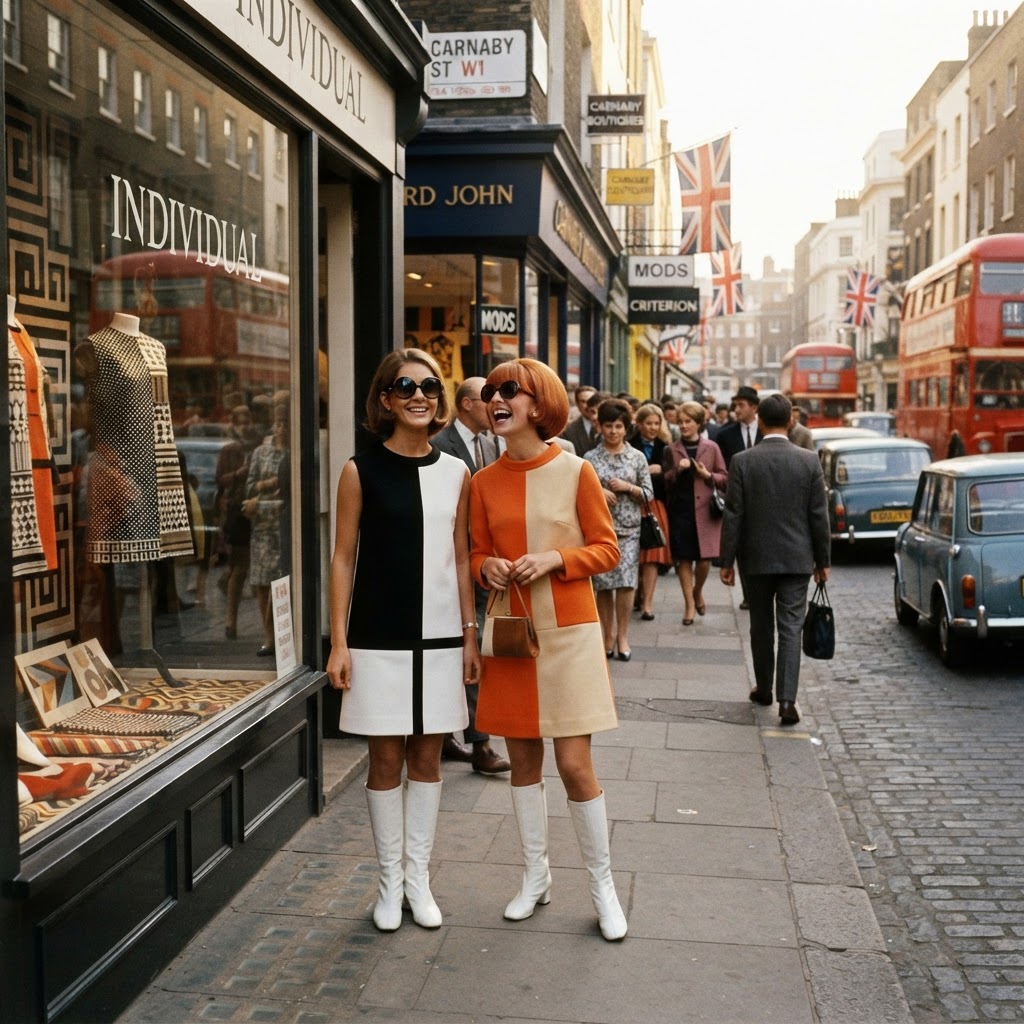
The word "mod" itself is shorthand for modernist, a term borrowed from a subcultural tribe of jazz-obsessed youth who prized sharp tailoring and a forward-thinking attitude. By the mid-1960s, the look had evolved into something unmistakably visual: clean geometric lines, bold graphic prints, abbreviated hemlines, and a palette that swung wildly between stark black-and-white contrast and eye-popping op-art color.
The Designers Who Defined It
No conversation about mod fashion begins anywhere other than Mary Quant. The Chelsea-based designer is widely credited with popularizing — if not outright inventing — the miniskirt, which she reportedly named after her favorite car, the Mini Cooper. Quant's Bazaar boutique on the King's Road became a pilgrimage site for fashion-forward young women who wanted clothes that moved with them, not against them. Her designs were joyful, irreverent, and deeply democratic: fashion for the girl on the high street, not just the socialite.
Meanwhile, André Courrèges and Pierre Cardin brought a futurist dimension to the mod aesthetic from Paris, draping models in vinyl, PVC, and structured shift dresses that looked borrowed from a space-age fantasy. Courrèges' white go-go boots became one of the decade's most iconic accessories — a piece of footwear so radical it still reads as bold today.
On the menswear side, tailors along Carnaby Street — most famously John Stephen, dubbed the "King of Carnaby Street" — were dressing young men in slim-cut suits, bold striped shirts, Chelsea boots, and velvet blazers. The mod man was as invested in his appearance as any woman, a genuinely revolutionary idea for the era.
The Silhouette: Geometry as Philosophy
What made mod fashion so visually arresting was its commitment to geometric simplicity. The shift dress became the movement's essential garment: a straight-cut, sleeveless or short-sleeved dress that fell well above the knee, eliminating the waist-cinching and full skirts of the 1950s in favor of something linear and uncluttered.
Prints leaned heavily into op art, a visual art movement pioneered by artists like Bridget Riley, whose disorienting patterns of black and white shapes translated thrillingly onto fabric. Bold color blocking — stark panels of contrasting solid hues — gave garments an almost architectural quality. Everything felt deliberate, modern, and slightly futuristic, as if the designers were dressing women not for 1965 but for 1985.
Accessories doubled down on the aesthetic: oversized round sunglasses, low-heeled go-go boots, wide plastic bangles, and structured box handbags all reinforced the look's clean, almost graphic quality. Hair and makeup completed the picture — the blunt geometric bob popularized by Vidal Sassoon framed faces painted with white or pale pink lips, heavy eyeliner, and enormous false lashes that made the eyes the focal point of the entire look.
The Icons Who Wore It
A fashion movement only becomes a cultural moment when the right faces inhabit it. For mod, those faces were unforgettable.
Twiggy — born Lesley Lawson — arrived in 1966 like a human exclamation point. At 16, her boyish frame, enormous painted-on lower lashes, and close-cropped hair made her the ideal canvas for mod's geometric vision. She didn't just wear the clothes; she embodied the movement's entire ethos of youth, lightness, and freedom from convention.
Jean Shrimpton, photographed endlessly by David Bailey, brought a slightly more languid glamour to the aesthetic. Edie Sedgwick, orbiting Andy Warhol's Factory in New York, exported mod sensibility across the Atlantic, proving the look could thrive far beyond London. And Brigitte Bardot's occasional mod-adjacent moments reminded the world that the style had a continental dimension, too.
On screen, films like Blow-Up (1966) and Darling (1965) documented and amplified the look, cementing it in the cultural memory of the decade.
Mod Crosses the Atlantic
By the mid-1960s, mod's invasion of America was well underway. Department stores like Macy's created dedicated mod boutique sections. Mass-market manufacturers produced affordable versions of shift dresses and op-art prints for millions of American women who had never set foot on Carnaby Street.
The "Youthquake" — a term coined by Vogue editor Diana Vreeland — described this seismic generational shift in who fashion was designed for. For the first time, the industry was actively chasing youth rather than maturity, a paradigm shift whose reverberations are still felt today in every campaign that casts teenagers to sell luxury goods.
American designers like Betsey Johnson, then designing for the Paraphernalia boutique in New York, added their own irreverent energy to the movement, incorporating vinyl, metallic fabrics, and noise-making elements into garments that were as much performance art as clothing.
The Legacy: Mod's Endless Afterlife
Mod fashion has never really left. It has simply cycled in and out of the foreground, influencing successive generations of designers and style tribes with the persistence of a great idea.
The 1990s brought a notable mod revival, with designers like Prada embracing the shift silhouette and geometric print in collections that felt simultaneously retro and fresh. Oasis and the broader Britpop movement in the UK consciously invoked mod's visual language — parkas, target logos, and slim-cut tailoring — as a form of cultural memory.
More recently, Gucci under Alessandro Michele played extensively with 1960s references, while the enduring popularity of shows like Mad Men introduced mod-adjacent fashion to a new generation and sent vintage collectors scrambling for authentic pieces.
On a deeper level, mod's philosophical legacy is perhaps even more significant than its aesthetic one. The movement established, almost permanently, the idea that youth culture drives fashion rather than following it. It democratized style, insisting that what you wore could be as creative and expressive as any fine art. And it gave women clothing that prioritized movement and freedom over decoration and constraint — a gift that contemporary fashion is still, in many ways, unwrapping.
Shopping Mod: What to Look For
If you're looking to build a wardrobe with genuine 1960s mod pieces — or high-quality vintage inspired by the era — a few key items are worth hunting for:
- Shift dresses in solid bold colors, op-art prints, or geometric patterns
- Space-age accessories: white or silver go-go boots, mod sunglasses, wide plastic bangles
- Slim-cut men's suits in bold checks or solid colors with narrow lapels
- Vinyl or faux-patent handbags in structured boxy shapes
- Knit or crocheted dresses in the late-60s transitional style
Condition, provenance, and label matter enormously with true 1960s pieces. Names like Mary Quant, Courrèges, Pucci (for the psychedelic end of the spectrum), and early Betsey Johnson for Paraphernalia are the holy grail. But even unlabeled pieces from the era carry an authenticity of construction and material that modern reproductions rarely match.
Find Your Mod Moment at Ensemble
The beauty of vintage fashion is that history isn't just something you study — it's something you wear. At Ensemble, our curated marketplace brings together authenticated vintage pieces from the 1920s through the 2010s, including a carefully sourced selection of 1960s mod clothing and accessories. Whether you're building a historically faithful wardrobe, seeking a single statement piece, or simply drawn to the joyful geometry of the era, Ensemble is the place to find the real thing — worn once by someone who lived through the revolution, and ready to be worn again by you.