How to Spot an Authentic Vintage Handbag: The Ultimate Buyer's Guide
Vintage handbags are more than accessories — they're wearable history, each stitch and clasp telling the story of a bygone era. But in a market flooded with reproductions and misattributed pieces, knowing what to look for can mean the difference between a genuine treasure and a costly mistake. Whether you're hunting for a 1940s structured satchel or a 1980s power-shoulder clutch, this guide will help you shop with confidence.
How to Spot an Authentic Vintage Handbag: The Ultimate Buyer's Guide
There is something undeniably thrilling about holding a handbag that has survived decades of fashion revolutions. Vintage bags carry with them a tactile richness — the weight of real brass hardware, the soft patina of aged leather, the careful symmetry of hand-stitched seams — that modern mass production simply cannot replicate. But authenticity in the vintage market is everything, and savvy shoppers know that a beautiful bag is only as valuable as its provenance. Here is what to look for when adding an authentic vintage handbag to your collection.
1. Understand the Era You're Shopping
Before you examine a single stitch, orient yourself in time. Handbag silhouettes, materials, and construction techniques changed dramatically from decade to decade, and knowing the hallmarks of each era is your first line of defense against misdated or misrepresented pieces.
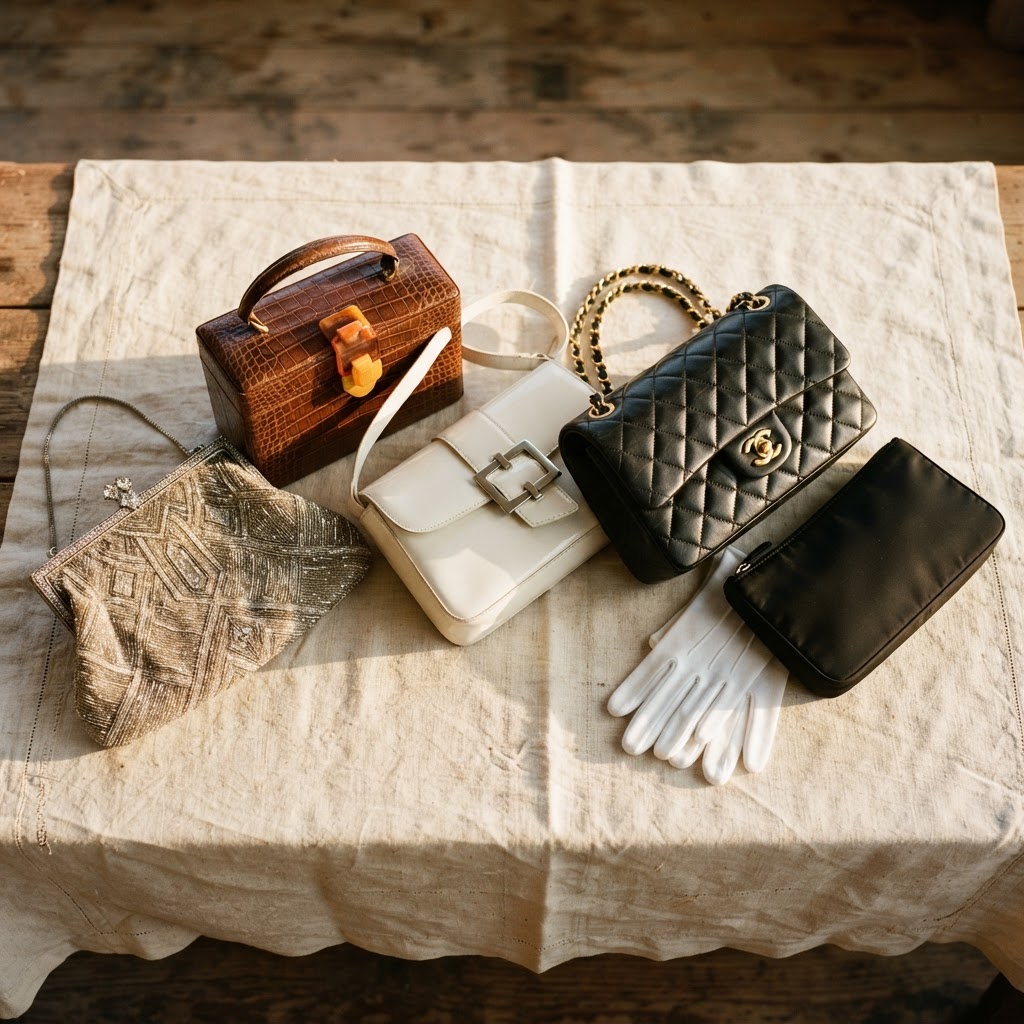
- 1920s–1930s: Look for beaded evening bags, Art Deco geometric closures, and delicate chain handles. Materials like silk, velvet, and petit point embroidery dominate. Bags were small — evening purses barely larger than a hand — reflecting the era's emphasis on ornament over utility.
- 1940s–1950s: Wartime rationing gave way to postwar optimism. Expect structured box bags, Bakelite clasps, and alligator or crocodile leather (genuine exotic skins were common and legally traded). The 1950s introduced the ladylike top-handle bag, stiff and architectural in silhouette.
- 1960s–1970s: Mod geometric shapes, psychedelic prints, and the rise of canvas and coated fabric mark the 1960s. The 1970s brought boho fringe, woven leather, and the first major wave of logo-driven designer bags.
- 1980s–1990s: Power dressing meant oversized clutches, quilted chain bags à la Chanel, and the dominance of monogram canvas from luxury houses. The 1990s pivoted to minimalism — clean lines, nylon, and the birth of the It bag phenomenon.
- 2000s–2010s: Embellishment returned with logo-mania, studded hardware, and statement shapes. Bags from this era are just crossing into vintage territory, so condition and documentation matter especially here.
2. Examine the Hardware Closely
Hardware is one of the most revealing indicators of a bag's age and authenticity. Authentic vintage pieces used materials that were heavier and more labor-intensive than contemporary equivalents. Run your fingers over clasps, zippers, chains, and feet.
Look for solid brass or gold-filled hardware on pre-1980s pieces — it will feel substantial and may show natural tarnishing or oxidation that develops over decades, not artificially distressed finishes. Zippers are a powerful dating tool: the brand Talon dominated American zipper production from the 1930s through the 1960s, while Éclair was prevalent in European bags of the same period. A YKK zipper on a bag claimed to be from the 1940s is a red flag. Check zipper pulls for engraved house logos, which were standard on luxury bags from the 1970s onward.
Also inspect the stitching around hardware mounts. Hand-sewn attachment points with consistent, fine stitches indicate quality craftsmanship, while machine-uniform stitching in synthetic thread points to a later or lower-end production.
3. Read the Lining Like a Text
A bag's interior lining is a surprisingly rich source of information. Authentic vintage bags were typically lined with natural fabrics — silk charmeuse, moiré taffeta, grosgrain, or fine cotton twill — in the earlier decades. Synthetic linings (nylon, polyester) became common from the late 1960s onward, so a poly lining on a purported 1950s bag warrants scrutiny.
Look for interior labels or stamps. Many American department stores — Saks Fifth Avenue, Bonwit Teller, I. Magnin — affixed their own labels to bags sold through their boutiques, providing useful dating context. European designers often stamped the leather interior directly with the house name, country of manufacture, and sometimes a serial number. Research the typography and format of these stamps: font styles, logo iterations, and country-of-origin labeling laws all changed over time, and cross-referencing against known authentic examples is essential for high-value pieces.
4. Assess the Leather (or Fabric) Quality
Not all vintage bags are leather, but when leather is present, it tells a story. Full-grain and top-grain leather age differently than bonded leather or vinyl — they develop a patina, softening and deepening in color at stress points like handles and corners. This natural aging is nearly impossible to convincingly fake on a mass scale.
Press gently on the surface. Genuine leather will yield slightly and feel warm; vinyl or bonded leather feels colder, more uniform, and may show cracking in a spiderweb pattern rather than the linear creasing of real hide. Smell is also a legitimate tool: aged leather has a distinctive, complex aroma — earthy, slightly sweet — while synthetic materials smell chemical or neutral even after decades.
For fabric bags — tapestry, needlepoint, woven straw — examine the weave density and the finish of the edges. Hand-finished edges on woven bags, where individual threads are folded and stitched rather than glued, indicate pre-mass-production craftsmanship.
5. Scrutinize the Stitching
Stitching quality is the heartbeat of a vintage bag. Count stitches per inch: high-end vintage bags typically feature 8–10 stitches per inch in saddle stitch or lock stitch construction. The thread should be consistent in tension — neither puckering nor gaping — and ideally match or complement the bag's color in a deliberate way.
On designer pieces, stitching is often the first thing counterfeiters get wrong. Cross-reference the stitch count, thread color, and stitch placement with authenticated reference images. A crooked topstitch or uneven welt seam on a piece attributed to a top luxury house is cause for pause.
6. Verify Provenance and Documentation
When shopping at a reputable vintage marketplace, provenance documentation significantly increases confidence and value. This can include:
- Original dust bags or boxes with period-correct branding
- Receipts or authentication cards (more common from the 1980s onward for luxury pieces)
- Photographs of the original owner carrying the bag
- Seller provenance statements documenting how and where the piece was acquired
For high-value designer bags, consider requesting a third-party authentication from services like Entrupy or a specialist auction house before finalizing a purchase. This is especially important for sought-after pieces from Hermès, Chanel, and Louis Vuitton, where the premium market attracts sophisticated fakes.
7. Know the Red Flags
Arm yourself with a mental checklist of warning signs:
- Anachronistic materials: polyester lining on a 1940s bag, modern YKK zippers on a 1950s piece
- Inconsistent aging: hardware that looks artificially distressed while leather shows no patina
- Mismatched fonts on labels or stamps compared to verified examples
- Overly perfect condition on a piece claimed to be 60+ years old without a clear storage history
- Vague provenance: sellers unable to describe where or how they acquired the piece
Conclusion: Shop Smart, Shop Ensemble
Authentic vintage handbags are investments in craft, history, and personal style that reward the careful shopper. Every detail — the weight of a brass clasp, the scent of aged leather, the typography on an interior stamp — is a clue waiting to be decoded. The more you handle verified authentic pieces, the more attuned your eye and hand become to the real thing.
At Ensemble, every handbag listed on our marketplace is vetted by our team of vintage specialists before it reaches your screen. We believe that shopping vintage should be joyful, not anxiety-inducing, which is why we do the provenance legwork so you can focus on finding the piece that speaks to you. Browse our curated selection of authentic vintage handbags — from beaded 1920s evening bags to iconic 1990s It bags — and bring a little wearable history into your everyday life.