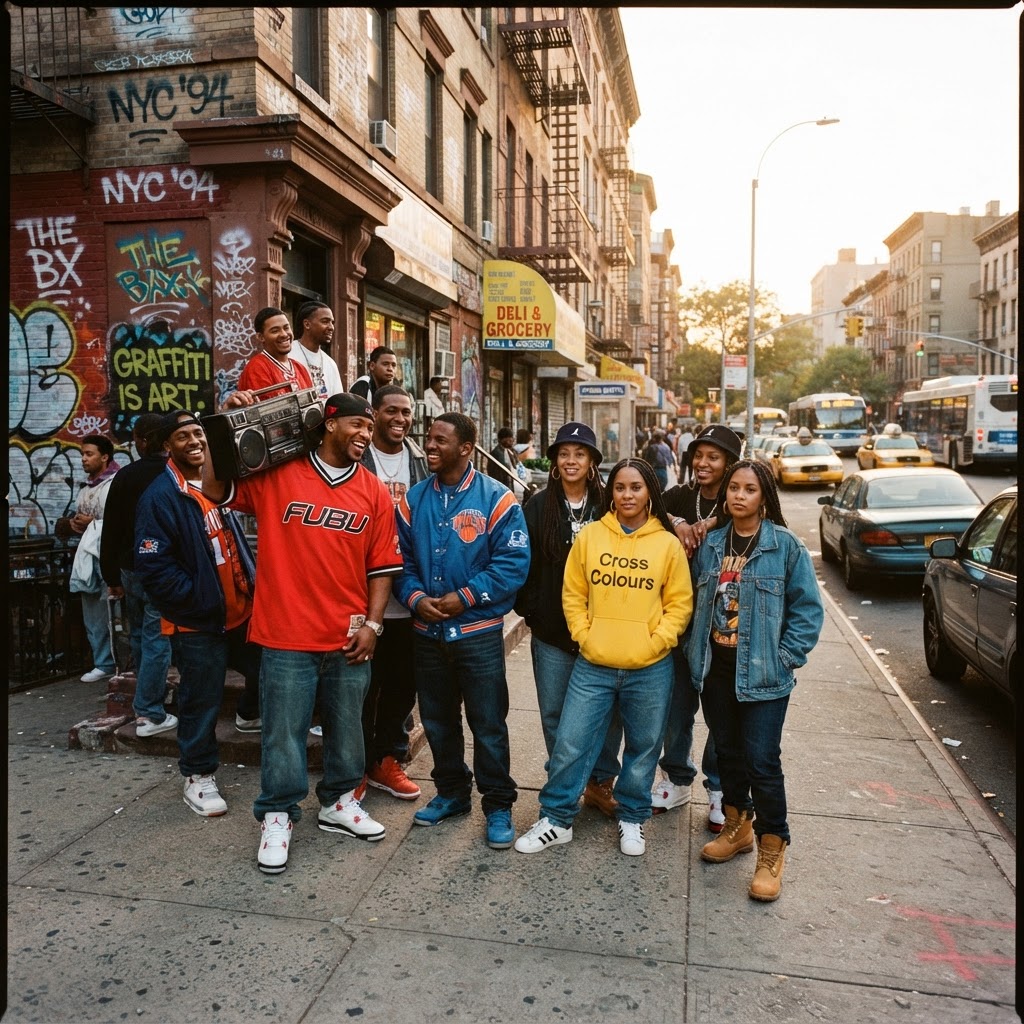
From the Block to the Runway: The Cultural Legacy of 1990s Hip-Hop Streetwear
Few fashion movements have reshaped the global style landscape as decisively as 1990s hip-hop streetwear. What began as self-expression in the neighborhoods of New York, Los Angeles, and Atlanta evolved into a multi-billion-dollar cultural force that still drives trends today. Understanding where it came from — and what it meant — is essential to appreciating every oversized jersey, Timberland boot, and logo-heavy tracksuit that survives from that era.
The Streets as a Runway
Long before luxury fashion houses were borrowing from hip-hop culture, the communities that created rap music were building an entirely original aesthetic vocabulary. In the early 1990s, style in Black urban neighborhoods was not simply about clothing — it was communication. What you wore signaled where you were from, who you ran with, and how seriously you took yourself. Fashion was identity made visible.
The look that emerged was bold and deliberate. Oversized silhouettes dominated — baggy jeans worn low, XL hoodies that swallowed the frame, and puffer jackets that made a statement on cold city corners. This wasn't sloppiness; it was a conscious rejection of the fitted, preppy aesthetics that mainstream America associated with respectability. Hip-hop streetwear said, in no uncertain terms, that Black youth would define their own standards of cool.
The Labels That Defined the Decade
Certain brands became synonymous with the 1990s hip-hop aesthetic, some by design and some by organic adoption. FUBU — an acronym for "For Us, By Us" — was perhaps the most politically charged fashion statement of the era. Founded by Daymond John in Hollis, Queens, FUBU was a direct declaration of economic and cultural self-determination. When LL Cool J wore FUBU gear in a Gap advertisement (famously sneaking in the brand without the Gap's knowledge), it became a legendary act of brand loyalty.
Karl Kani, Cross Colours, and Mecca USA similarly built empires on the foundation of hip-hop identity. Cross Colours in particular embedded social messaging directly into its garments, printing phrases like "Stop the Violence" and "Educate 2 Elevate" across its brightly colored pieces. These weren't just clothes — they were wearable manifestos.
Meanwhile, Tommy Hilfiger and Ralph Lauren Polo were being recontextualized by hip-hop artists and fans. The Wu-Tang Clan's Raekwon famously rapped about Polo, and the Lo-Lifes — a Brooklyn crew — built an entire subculture around collecting and wearing Ralph Lauren. These preppy, historically white-coded brands were reclaimed and reinterpreted, stripped of their country-club associations and recharged with street credibility.
Sportswear and the Hip-Hop Uniform
Athletic wear played a central role in defining the decade's streetwear canon. Nike Air Jordans, introduced in the mid-1980s, reached peak cultural saturation in the 1990s. Owning the right pair of sneakers was a matter of status, and the sneaker economy that exists today — with its drops, resale markets, and collector culture — was essentially born in this era.
Adidas tracksuits, inspired in part by Run-DMC's pioneering style from the late 1980s, remained staples throughout the 1990s. Champion hoodies, Starter jackets (particularly those featuring NBA and NFL team logos), and Nautica windbreakers all achieved iconic status. The genius of hip-hop streetwear was its ability to elevate everyday athletic and workwear items into high-status fashion objects through the alchemy of cultural association.
Timberland boots deserve special mention. Originally marketed to outdoor laborers and construction workers, the wheat-colored six-inch boot was adopted by hip-hop communities in New York and quickly became one of the most recognizable symbols of 1990s street style. Timberland's transformation from workwear to streetwear is a perfect case study in how hip-hop culture could completely redefine the meaning of a garment.
West Coast and Southern Flavors
While New York City was the original epicenter of hip-hop fashion, the 1990s saw powerful regional styles emerge from both coasts and the South. West Coast gangsta rap, pioneered by artists like Dr. Dre, Snoop Dogg, and Ice Cube, brought a distinctly Californian aesthetic: Dickies work pants, plain white T-shirts, flannel shirts buttoned only at the top, and Cortez sneakers. The palette was often muted — navy, white, black, and grey — in contrast to the brighter colors popular in New York.
Atlanta's emerging rap scene introduced another dimension, with artists beginning to experiment with designer label prominance and a more luxurious spin on street style that would fully blossom in the early 2000s. The seeds of what would become bling culture were planted in the mid-to-late 1990s South.
Women, Hip-Hop, and Streetwear
The story of 1990s hip-hop fashion cannot be told without centering its women. TLC pioneered an androgynous, colorful, and playful take on streetwear — baggy overalls, sports bras, and coordinated sets that were simultaneously athletic and fashion-forward. Missy Elliott pushed boundaries with avant-garde silhouettes that challenged conventional femininity entirely. Lil' Kim and Foxy Brown, meanwhile, introduced a hyperfeminine, maximalist, and unapologetically sexual counterpoint — form-fitting clothing, furs, and bold color combinations that were just as much a part of the hip-hop fashion conversation as anything worn by their male counterparts.
These women were not passive style recipients — they were active architects of the aesthetic, and their influence on subsequent decades of fashion (from the Y2K era through today's revival of 1990s looks) is immeasurable.
The Luxury Crossover
By the mid-to-late 1990s, the relationship between hip-hop and high fashion was becoming impossible to ignore. Versace, Gucci, and Fendi logos began appearing in rap lyrics and on artists' bodies. This wasn't simply aspiration — it was annexation. Hip-hop artists were signaling that they had arrived economically and that luxury fashion was now their territory too.
This crossover created one of fashion history's most productive tensions. Luxury brands were initially ambivalent, sometimes hostile, toward their new champions. But consumer reality was undeniable: hip-hop culture was driving sales in ways traditional marketing never could. The uneasy courtship of the 1990s would eventually become full-blown partnership by the 2000s, culminating in collaborations and creative director appointments that now define the luxury industry.
The Legacy That Never Left
The influence of 1990s hip-hop streetwear is not historical — it is present tense. Virgil Abloh, who passed in 2021, explicitly traced his entire design philosophy back to the hip-hop streetwear culture he grew up in. Dapper Dan, the Harlem designer who fused luxury logos with hip-hop sensibility in the 1980s and 1990s and was eventually vindicated by a Gucci collaboration, represents the full arc of this story. Every Supreme drop, every Yeezy release, every streetwear-luxury collaboration owes a direct debt to what was happening on the streets of Harlem, Compton, and Atlanta thirty years ago.
The vintage market for 1990s streetwear has exploded accordingly. Original FUBU jerseys, Starter jackets, Lo-Life Polo pieces, and early Air Jordan colorways command serious prices from collectors and fashion enthusiasts who understand that these garments are primary historical documents of one of the most important cultural movements of the twentieth century.
Find Your Piece of the Story at Ensemble
At Ensemble, we believe that authentic vintage clothing carries meaning that reproductions simply cannot replicate. Our curated collection of 1990s hip-hop streetwear pieces — from original Starter jackets and FUBU jerseys to vintage Nautica windbreakers and Champion hoodies — allows you to own a genuine fragment of this extraordinary cultural moment. Whether you're a collector, a fashion enthusiast, or simply someone who wants to dress with historical intention, browsing our 1990s archive is an education and an opportunity. The story of hip-hop streetwear is one of creativity, resistance, commerce, and pride — and every piece in our marketplace is a chapter worth wearing.