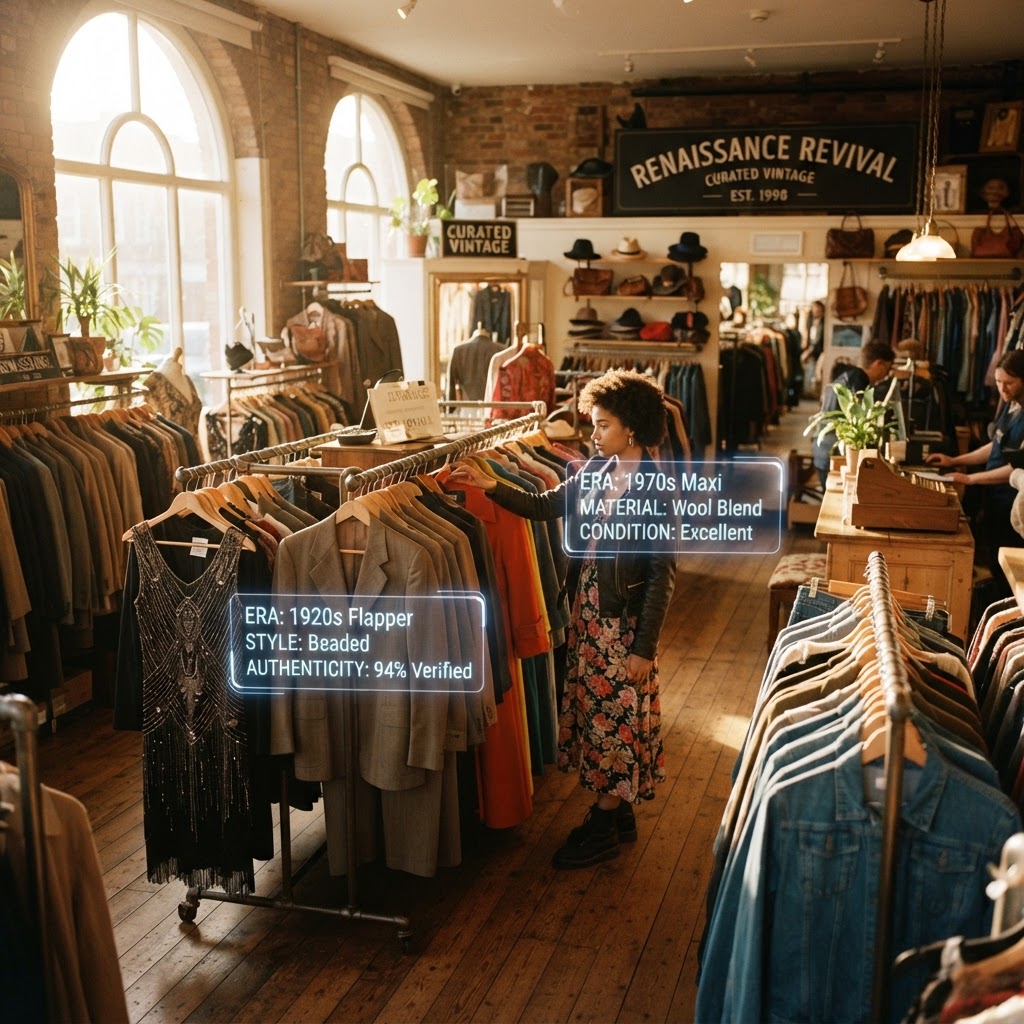
Dressed by Data: How AI Is Revolutionizing the Vintage Fashion Marketplace
Artificial intelligence is quietly transforming every corner of the fashion world — and the vintage market is no exception. From smarter search tools to instant authentication, AI is making it easier than ever to find, sell, and fall in love with clothing from decades past. Here's how the technology is reshaping the way we shop for history.
The Vintage Boom Meets the Algorithm
Vintage fashion has never been more popular. Across TikTok, Instagram, and the pages of major style publications, clothing from the 1920s through the 2000s is having a prolonged, glorious moment. Shoppers are drawn not just to the quality and uniqueness of older garments, but to the stories stitched into every seam. Yet for all its romance, the vintage market has historically been difficult to navigate — inconsistent sizing, murky provenance, and the sheer volume of listings across dozens of platforms can make finding the perfect piece feel like searching for a needle in a very stylish haystack.
Enter artificial intelligence. In the past few years, AI-powered tools have begun to change the mechanics of buying and selling vintage clothing in profound ways, making the market more accessible, more trustworthy, and frankly more fun. Whether you're a seasoned collector hunting for an authentic 1940s swing dress or a first-time seller trying to price a box of 1990s denim, AI is quietly working behind the scenes to smooth the experience.
Smarter Search, Deeper Discovery
One of the most immediately noticeable changes AI has brought to vintage shopping is the evolution of visual search technology. Traditional keyword searches demand that shoppers already know what they're looking for — a tall order when you're trying to describe the exact cut of a 1970s lapel or the particular shade of a 1960s mod shift dress. Visual search tools, powered by computer vision models, allow users to upload a photo — a screenshot from a film, a picture of their grandmother, a runway image — and find visually similar garments in seconds.
This technology doesn't just benefit buyers. Sellers who might struggle to identify a garment's exact era or style can use AI image recognition tools to get a more precise read on what they have, helping them write better listings and reach the right audiences. When a listing is more accurate, everyone wins.
Beyond visual search, recommendation algorithms trained on user behavior are getting remarkably good at understanding personal style across decades. Rather than serving up random results, these systems learn that a shopper who loves 1950s circle skirts might also adore a 1980s puff-sleeved blouse — a connection a human stylist might make intuitively, and that AI is now beginning to replicate at scale.
The Authentication Revolution
If there is one issue that has long plagued the vintage market, it is authentication. Distinguishing a genuine 1930s silk bias-cut gown from a later reproduction requires expertise that most buyers simply don't have. Counterfeit or misrepresented items erode trust and can cost collectors significant sums of money.
AI is beginning to address this in meaningful ways. Machine learning models trained on thousands of garment images can now analyze fabric weave patterns, label typography, zipper styles, and stitching techniques to help determine whether a piece is consistent with its claimed era. Some platforms are experimenting with tools that cross-reference these visual details against historical databases of manufacturing techniques, giving buyers a confidence score alongside any listing.
This doesn't replace human expertise — a seasoned vintage dealer's eye remains invaluable — but it provides an important first layer of verification and can flag listings that warrant closer scrutiny. For buyers who are newer to the market, this kind of AI-assisted due diligence can be genuinely transformative.
Pricing the Past: AI and Valuation
One of the most challenging aspects of selling vintage clothing has always been pricing. Unlike new retail, there is no manufacturer's suggested retail price for a 1920s beaded flapper dress or a deadstock 1985 band tee. Sellers have historically relied on a combination of personal experience, comparable sold listings, and gut instinct.
AI-driven dynamic pricing tools are now analyzing thousands of recent sales across multiple platforms to generate real-time price recommendations. These models factor in decade, condition, brand (where applicable), current trend cycles, and even seasonal demand. A 1990s slip dress, for instance, surges in value every time that particular aesthetic recycles through contemporary fashion — and an AI model tracking those trend waves can help sellers time their listings for maximum return.
For buyers, similar tools can flag when a listing appears overpriced relative to recent comparable sales, providing a layer of market intelligence that was once available only to professional dealers.
Sustainability, Storytelling, and the Human Element
It would be easy to assume that AI's growing role in vintage fashion risks stripping the market of its most essential quality: human connection. After all, part of what makes vintage shopping magical is the serendipity of it — the unexpected find, the garment with a story, the connection to a particular moment in history.
But the most thoughtful applications of AI in this space are being designed to enhance that storytelling, not replace it. Natural language generation tools can help sellers craft richer, more evocative descriptions of their pieces — weaving in historical context, cultural references, and styling suggestions that bring a garment to life on the page. Imagine a listing for a 1940s utility suit that not only describes the cut and condition, but contextualizes the piece within the fabric rationing of wartime Britain. That kind of depth turns a transaction into an education.
Meanwhile, AI's role in sustainable fashion deserves recognition. By making it easier to find, authenticate, price, and sell secondhand clothing, these technologies are actively reducing the friction that pushes consumers toward fast fashion. Every vintage piece that finds a new home is one fewer garment in a landfill, and AI is quietly making those connections happen more efficiently than ever before.
What Collectors and Casual Shoppers Should Know
If you're new to vintage shopping in the age of AI, a few things are worth keeping in mind. First, AI tools are aids, not authorities. Use visual search and authentication assistance as starting points, but develop your own eye over time. Read about the construction details that distinguish each decade. Handle garments when you can. Talk to dealers.
Second, be aware that algorithms reflect the data they're trained on. A recommendation engine optimized for high sales volume may surface popular eras over rarer, more obscure decades. If you're hunting for something genuinely unusual — a 1920s tea gown or an early 1960s space-age piece — don't rely solely on algorithmic suggestions. Dig deeper.
Third, embrace the tools that save you time without surrendering the joy of discovery. Let AI handle the tedious work of price comparison and authentication flagging so that your energy can go toward the parts of vintage shopping that no algorithm can replicate: the thrill of recognition, the pleasure of style research, the satisfaction of wearing something with a real history.
The Future of Fashion's Past
We are still in the early chapters of AI's relationship with the vintage market. In the years ahead, we can expect even more sophisticated tools: augmented reality fitting rooms that let you visualize how a 1970s maxi coat would look on your frame, blockchain-based provenance records that trace a garment's ownership history, and AI curators that build personalized capsule wardrobes from across the decades.
Through all of this change, the best vintage marketplaces will be those that use technology in service of the culture — honoring the history, craft, and artistry embedded in every piece while making that world more accessible to new generations of shoppers.
At Ensemble, we believe that vintage clothing is more than merchandise — it's material history, wearable art, and a meaningful alternative to the disposable culture of fast fashion. As AI tools evolve, we're committed to integrating them thoughtfully, always in ways that deepen your connection to the pieces you discover here rather than diminishing it. Because the future of fashion, it turns out, is very much rooted in the past.